Photographers › Photographic Equipment Service & Repair
Booking Photographic Equipment Service and Repair Online vs. In Person: What Changes, What Does Not
When a camera fails, the first decision is not who fixes it. It is how you reach them. The modern repair market offers two doors: the online door — manufacturer service portals and independent mail-in specialists, where the relationship is a tracking number — and the in-person door, the local repair bench, where the relationship is a conversation across a counter. Creators and sellers who need working gear to make money feel the difference in their schedules and their wallets, because a camera in transit is a camera not earning.
I book photographers for events, and I have managed the repair logistics that keep them working. The honest comparison is not "online bad, local good" or the reverse. Some things genuinely change between channels — price structure, diagnostic quality, accountability, turnaround. Some things stubbornly do not: the bench fee, the parts problem, and the fact that no channel can repair a camera whose parts no longer exist. Here is both halves of that ledger.
What the work costs, whichever door you choose
Repair pricing is set by the job, not the channel, and the published ladder is consistent across the country:
| Job | Typical US price | Notes |
|---|---|---|
| Bench / estimate fee | $24–$85 | Opening the camera, diagnosing, quoting. Sometimes credited toward the repair, sometimes not — the first question to ask in either channel |
| Clean and check | $25–$58 | External and accessible-internal clean, function and shutter-speed checks |
| Sensor cleaning | About $50–$120 | Canon-authorized service benchmarks run $60–$120; independents often less |
| Tune-up / CLA | About $125–$325 | Partial to full strip, clean, re-lubricate, recalibrate shutter and meter |
| Lens work | Stuck aperture from about $78; most zoom repairs $128–$228 plus parts; fungus removal $78–$228 | Parts availability decides feasibility more than price does |
| LCD replacement | $100–$160 point-and-shoot; $150–$250 DSLR | Plus parts reality: screens for discontinued models vanish |
| Full overhaul | $278–$378 | Complete teardown and rebuild; on a $150 film camera, this is a replace-it signal unless the camera is that camera |
| Autofocus / element work | AF repair $100–$250; lens element replacement $150–$400 | Manufacturer and authorized benchmarks |
Against that ladder, channel differences are real but second-order. One repair-market analysis puts independent shops typically 20–40 percent cheaper than manufacturer service centers, with faster turnaround — while manufacturer service buys genuine parts, factory specification, and warranty standing. Mail-in independents compete with local benches on the same jobs at similar prices, then add shipping to one side of the ledger and subtract your travel time from the other.
What changes online
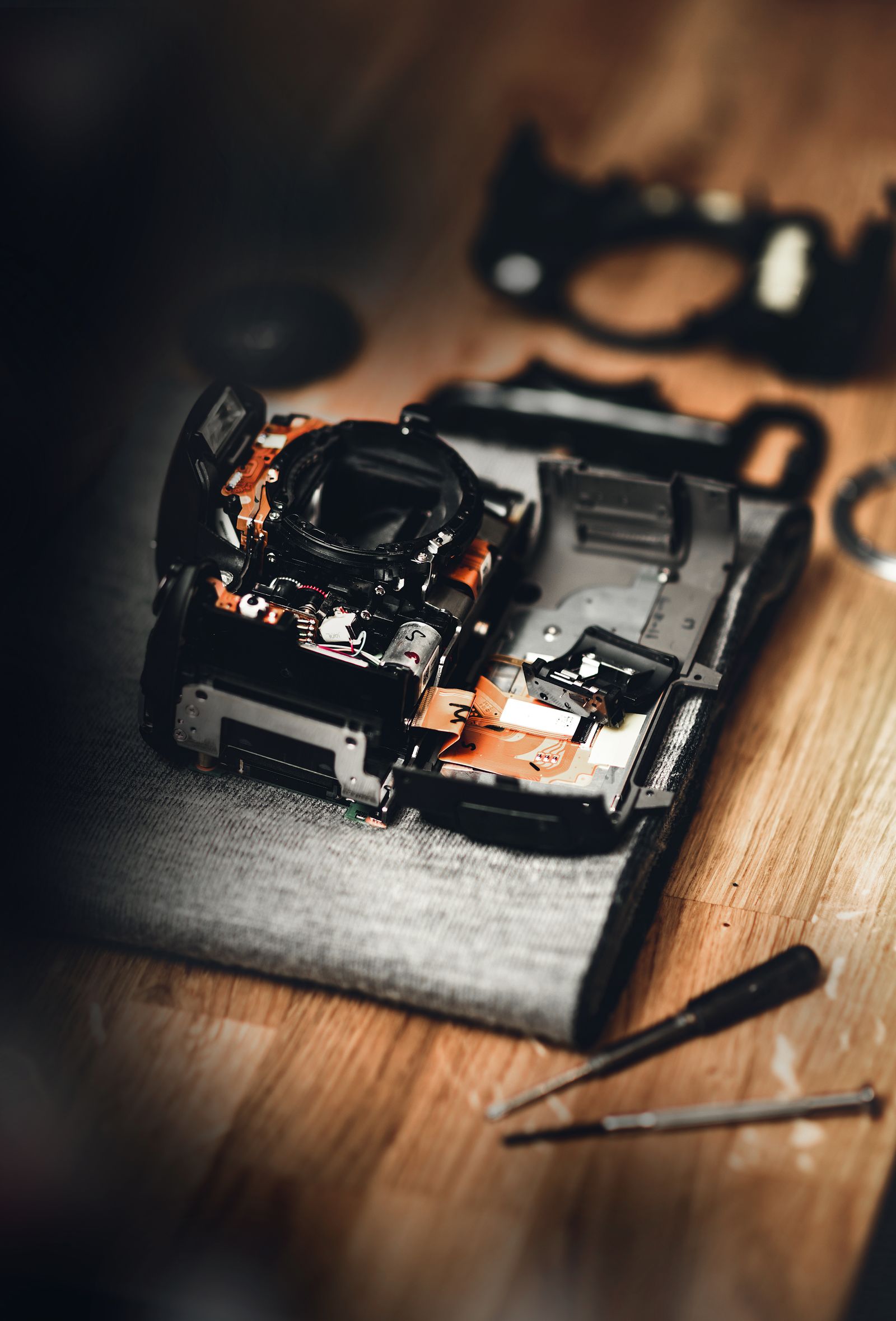
The estimate is two-stage, and the first stage is a guess. Manufacturer portals walk you through registration and an initial estimate online; once the factory service center receives the gear, it is re-evaluated, and the revised estimate governs. If you decline it, the gear comes back unrepaired and payments are refunded. Independent mail-in services run the same shape: a free estimate from your description, then diagnosis on the bench, then approval before work begins. The consequence is real — the price you "booked" online is provisional until a technician has the camera open. Budget holders who need a firm number before committing should treat the online quote as a range with a decision point in the middle, because that is what it is.
Shipping becomes part of the repair. Trackable, insured shipping is not a courtesy in the mail-in channel; Canon's own guidance to customers is to use a trackable and insurable service, and every cost and risk calculation changes accordingly. You pay to ship in (some mail-in services make return shipping free on completed repairs), you insure for the gear's real value, and you add transit days at both ends to the bench time. A repair quoted at a week can be a fortnight door to door; Canon's support describes its own process as usually under a week once the gear is in hand, with returns by second-day shipping, and cinema gear warranties at roughly seven to ten business days from arrival — the clock starts at their bench, not at your post office.
Choice explodes — and so does specialization. Online, the relevant market is national: the technician who overhauls classic Leicas, the shop that still services camcorders, the specialist with donor bodies for a discontinued model. Manufacturers themselves are mail-in for most of the country — Canon's US factory service centers are in Newport News, Virginia and Costa Mesa, California, which means "manufacturer service" is an online booking for almost everyone. For rare, old, or odd equipment, the online channel is not the alternative; it is the only door.
Accountability becomes documentary. Everything is written: the estimate, the approval, the tracking, the warranty — Canon's repair work carries a six-month repair warranty, and established mail-in services advertise up to six months as well. If something goes wrong, there is a paper trail by default. The flip side is that there is no person: a subtle fault — "it sticks, but only when it's cold" — must survive being typed into a form.
What changes in person
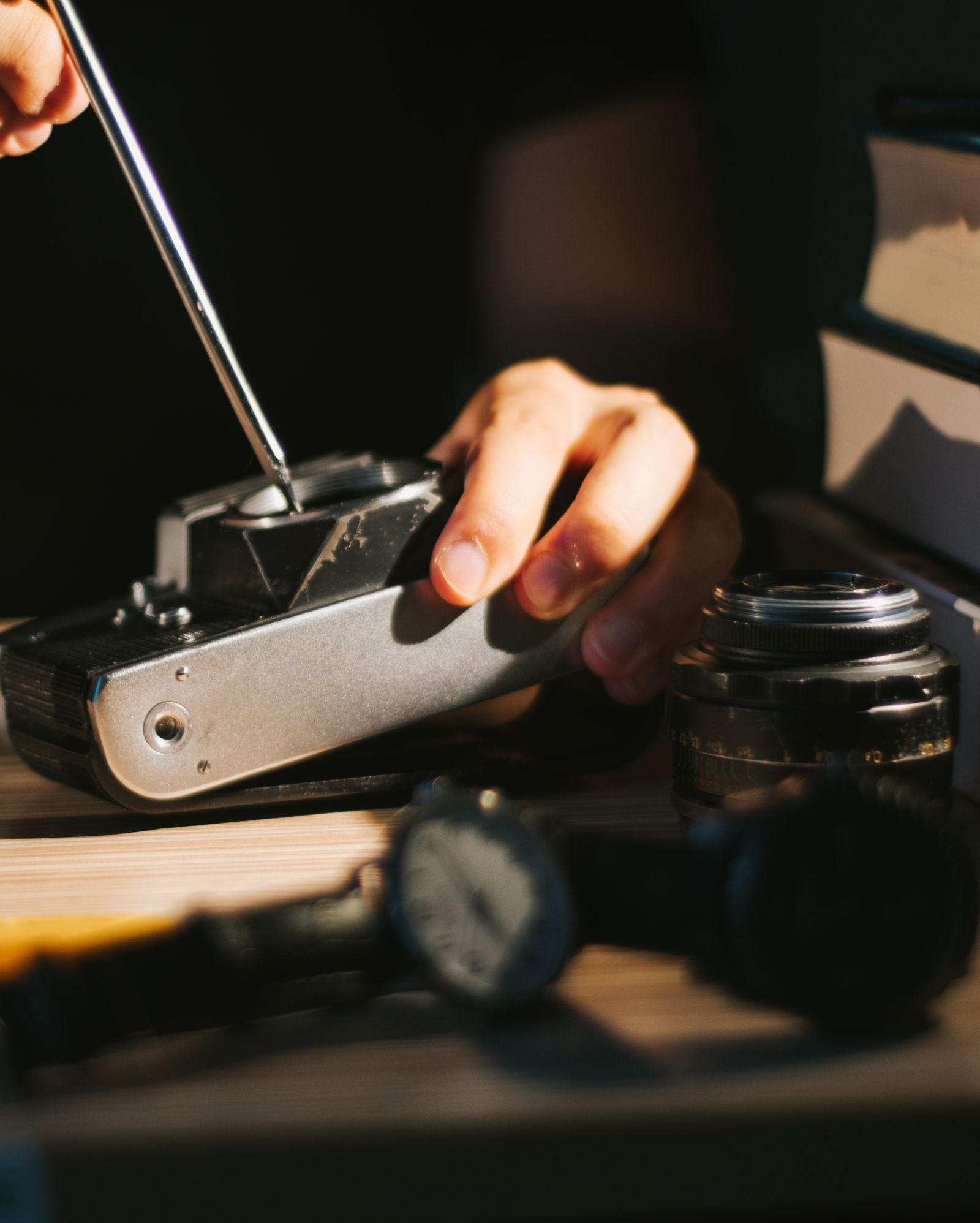
The diagnosis starts richer. Across a counter, a technician can put your lens on a body, fire the shutter while you describe the noise, and check the thing you forgot to mention. Intermittent faults, handling quirks, and "is this worth fixing?" conversations are simply better face to face. A good local bench will also tell you on the spot when a camera is not worth its overhaul — advice that saves the $278–$378 a mail-in process might take two weeks and two shipping charges to reach.
Turnaround can collapse — if the work is truly in-house. Published in-house benchmarks at an established repair shop: minor repairs with parts in stock in two to three business days; standard repairs needing parts, two to three weeks; factory service, four to six weeks. But the counter question that matters is the one repair guides repeat: "Is there a technician in the building, or do you send it out?" Plenty of camera stores accept repairs at the counter and ship them to a regional center or the manufacturer, adding a handling markup and transit at each end. That hybrid is exactly right for a warranty claim on a current body. It is a poor deal for an old mechanical camera, where you pay online-channel time for an in-person illusion.
Accountability becomes personal. The shop is there tomorrow; its local reputation is its marketing. That cuts both ways — a great bench is a relationship you will use for a decade, and a poor one has nowhere to hide — but the negotiation is human: rush pleas for a working professional with a Saturday booking are conversations a portal cannot have.
What does not change
- The bench fee logic. Both channels charge to diagnose — $24–$85 — and both may or may not credit it. Ask in either channel, before the camera leaves your hands.
- Parts are the hard limit. Discontinued models die of parts, not of faults. Independents stretch the limit with donor bodies and salvage stock — one classic-camera specialist is candid that despite a vast inventory of old stock, some classics are simply not serviceable — but no channel repeals it. This is also why the same repair on an aging camera gets more expensive every year.
- The estimate is provisional until the camera is open. True at the counter, true by mail. Anyone who quotes a firm price on an unseen internal fault is guessing in both channels.
- Warranty work belongs to the manufacturer. In-warranty and very new bodies with restricted parts go to authorized service regardless of your channel preference; independents are for out-of-warranty, older, and gray-market gear — one hard rule worth knowing is that Nikon will not service a gray-market import at any price, making an independent the only route for such a camera.
- Preparation is on you. Remove the battery and memory card, back up your images, note the serial number, describe the fault in writing, and pack like the parcel will be dropped — because in one channel it might be, and in the other, your future self needs the fault description anyway.
Which channel wins, job by job
| Job | Better channel | Why |
|---|---|---|
| Sensor cleaning, clean-and-check | In person | Cheap, quick, in-house everywhere; shipping would double the cost and the downtime |
| Warranty repair, current body | Online (manufacturer) | Authorized service is required; the portal is the front door |
| Classic film camera CLA or overhaul | Whichever reaches a real specialist | Local if your bench does classics; otherwise the national specialists online |
| Intermittent, hard-to-describe fault | In person | The diagnosis is a conversation and a demonstration |
| Discontinued or gray-market gear | Online independents | The broadest bench of specialists and donor parts |
| Deadline-critical pro repair | In person, if truly in-house | Two to three days for in-stock minor work beats any transit math |
Booking well in either channel
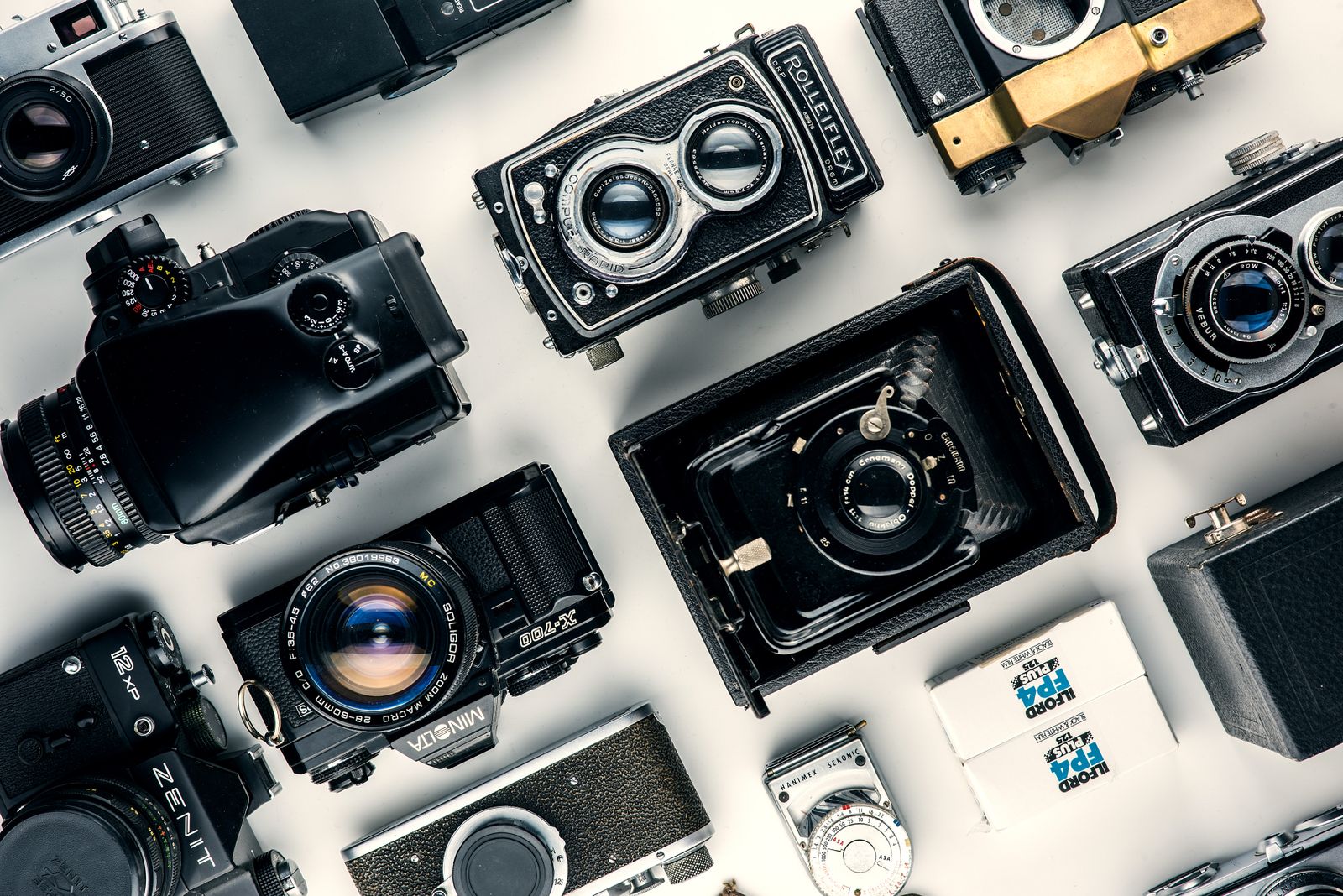
Get two quotes on anything over $200 — published overhaul prices alone span $278 to $378, and shops sit all across the range. Ask the three questions that decide everything: What is the bench fee and is it credited? Is the work done in-house, and what is the current backlog — two to four weeks is normal at a busy independent. What warranty covers the repair, and for how long?
This site lists 571 photographic equipment service and repair businesses and 47 camera service and repair specialists — the in-person bench still exists, and the online specialists are a search away. Choose the channel by the job, not by habit: ship the rare and the warrantied, carry the quick and the hard-to-explain. Either way, the camera comes back working or honestly condemned — and knowing which door gets you that answer fastest is the whole skill.
Sources
- CameraStores, "Camera Repair Costs — What a CLA, Overhaul and Bench Fee Really Run" — the published price ladder for bench fees, clean-and-check, CLA and overhaul; the in-house versus sent-out distinction; independent shops typically running 20–40 percent below manufacturer service.
- Precision Camera & Video, in-house repair price list — lens, flash and classic-camera pricing, clean-and-check at $58.50, overhauls at $278.50–$378.50, and turnaround benchmarks of 2–3 business days for minor in-stock work, 2–3 weeks for standard repairs and 4–6 weeks for factory service.
- Canon USA community support guidance — the mail-in repair flow of online estimate, re-evaluation on arrival, refund and return if the revised estimate is declined, typical turnaround under a week, second-day return shipping, a six-month repair warranty, and the advice to ship by a trackable, insurable service; factory service centers in Newport News, Virginia and Costa Mesa, California.
- US Camera Repair, mail-in service pages — free estimates from a description, nationwide mail-in intake, free return shipping on completed repairs, and warranties up to six months.
- ItsVividLeaves, "Camera and Lens Repair: Understanding the Estimate" — authorized-service benchmarks including sensor cleaning at $60–$120, autofocus repair at $100–$250 and lens element replacement at $150–$400, and independent diagnostic fees of $20–$50.
Photographs: disassembled camera — photo by Alex Andrews, https://www.pexels.com/photo/821642/ ; repair in hand — photo by Ahmet Polat, https://www.pexels.com/photo/5587333/ ; assorted cameras — photo by Alex Andrews, https://www.pexels.com/photo/assorted-black-and-gray-cameras-1983038/
More guides
- How to Find a Wedding Photographer: The Complete, Honest GuidePhotographers › Wedding Photographers
- How Much Does a Wedding Photographer Cost? Packages DecodedPhotographers › Wedding Photographers
- 10 Questions to Ask a Wedding Photographer Before You BookPhotographers › Wedding Photographers
- Wedding Photography Styles Explained: Documentary, Editorial, Traditional, Fine ArtPhotographers › Wedding Photographers
- Hiring a Wedding Photographer in California: Venue Light, Permits, and Price LevelsPhotographers › Wedding Photographers
- All Guides & ArticlesBrowse the full guides library