Photographers › Portrait & Commercial Photography
Booking Portrait and Commercial Photography Online vs. In Person: What Changes, What Does Not
Portrait and commercial photography have split into two buying worlds. In one, you open a marketplace, filter by style and price, pay a service fee at checkout, and receive a gallery link days later — no phone call, no meeting, sometimes no conversation at all. In the other, you sit down with a photographer, talk through a brief, receive a written estimate with line items for crew, studio and licensing, and negotiate terms like professionals in adjacent trades. If you create or sell products and your images have to convert browsers into buyers, the choice between those worlds is not about convenience. It changes what you are legally allowed to do with the photographs, what the job really costs, and who answers when something goes wrong.
I book photographers for a living, through both worlds. Here is where the channel matters, where it does not, and how to decide per job rather than by habit.
The two price systems you are choosing between
Online, commercial work is priced like a product. Marketplace and platform studios sell standardized units: a packshot at $25 to $75 an image, styled product photography at $50 to $350 an image, a one-hour shoot listed at $89 and an eight-hour shoot at $589 on one major platform's value tier — plus a 15 percent service fee at checkout. Freelancers booked through marketplaces cluster around $40 to $50 a finished product photo in most US metro markets. The units are transparent, comparable, and deliberately narrow: defined angles, defined retouching, web and marketplace usage assumed.
In person, commercial work is priced like a production. A direct commercial photographer's quote is built from a creative fee — $150 to $500 an hour, $800 to $2,000 for a half day, $1,500 to $4,000 for a full day in a major regional market; $1,500 to $5,000 or more per day for established advertising photographers — plus production costs (assistants, stylists, studio, props) passed through at cost plus a markup of typically 10 to 20 percent, plus the line that has no equivalent in the marketplace world: the usage license.
The license is the whole ballgame. In commercial photography you are not buying photographs; you are buying permission to use them. The photographer owns the copyright from the moment of exposure unless a written agreement says otherwise. A license is priced by media (web and social, e-commerce, print, packaging, out-of-home, broadcast), territory and duration — typically one to three years, renewable at 50 to 75 percent of the original fee. For substantial campaigns the license commonly runs 50 to 200 percent or more of the creative fee — it can exceed the cost of the shoot itself. A full buyout, where offered, prices at three to ten times the licensed figure and is rarely the efficient choice. Marketplace packages bundle a limited license invisibly into the per-image price — usually web and organic social use — which is exactly right for a listing photo and quietly inadequate for the same image on packaging, a paid ad campaign or a billboard, where extended usage is quoted separately or not sold at all.
| Online / marketplace | In person / direct | |
|---|---|---|
| Pricing unit | Per image ($25–$350), per hour, per package | Creative day fee ($1,500–$5,000+) plus production plus license |
| Platform cost | Service fee on top (e.g. 15%) | None — but production markup of 10–20% on billed-through costs |
| Usage included | Narrow bundle: web, listings, organic social | Negotiated: media, territory, term (1–3 years typical) |
| Paid ads / packaging / broadcast | Extended usage extra, sometimes unavailable | Priced as a license — can be 50–200%+ of the creative fee |
| Brief and art direction | Templates, shot lists, platform messaging | Meetings, treatments, estimates compared line by line |
| Reshoot and dispute route | Platform process and refunds | Your contract, your relationship, your lawyer if it comes to that |
| Best at | Standardized volume: catalogs, listings, refreshes | Campaigns, launches, anything with models, sets or media spend behind it |
What changes when you book online
Comparability. Twenty product photographers' per-image prices can be compared in an afternoon online; twenty direct estimates take two weeks of briefings. For standardized work — white-background packshots, consistent catalog angles, a founder portrait against a plain backdrop — that comparison is real information, and it disciplines the whole market: platform and marketplace pricing sits measurably below direct-hire ranges for equivalent simple work.
The brief gets thinner as the price gets clearer. A platform's order form captures angles, backgrounds and file specs beautifully. It captures "make our brand feel like the expensive option in this category" not at all. The more your images depend on judgment — styling that positions a product, a portrait that has to carry a company's credibility — the more the in-person process of treatments, mood boards and test frames is the product you are actually buying.
Accountability is procedural, not personal. Online, if the work fails, you invoke a process: revisions within the stated rounds, a dispute, a refund, a new photographer. It works, and it caps your loss at the job price. What it cannot do is care about your launch date. A direct photographer with a reputation in your industry and a relationship to protect will move heaven and earth on a reshoot; a platform will move your ticket to the next stage.
Your products travel; you don't. The mail-in model that marketplaces normalized — ship the products, receive the gallery — adds costs the listing price omits: shipping both ways at $30 to $150 a round trip, insurance on valuable samples, and a reshoot cycle measured in weeks if a marketplace rejects a main image or a shot misses the brief. Budget a tenth to a fifth of the spend for do-overs on a first job with any new provider, in either channel.
What does not change
Copyright. Identical in both worlds, and the single most misunderstood fact in commercial photography: paying for a shoot does not transfer ownership of the images. What changes is only how the license reaches you — bundled and narrow online, itemized and negotiable in person. Before any booking, in any channel, answer in writing: which media, which territory, how long, and what happens when the term ends — stop using the images, or renew, and at what price.
The shoot. A reflective bottle, a piece of jewelry, a dark product on a dark background — the hard shots are hard in every channel, and they price accordingly: complex products add 50 to 100 percent to per-image rates wherever you buy them. Skill is channel-blind.
Retouching tiers. Standard finishing — color, exposure, cleanup — is included in both worlds. High-end product retouching and compositing is extra in both: published contract guidance puts complex retouching at $25 to $250 or more per image. For sellers, this is where conversion is decided; a hero image deserves the expensive tier in either channel.
Releases. If a recognizable person appears in advertising use, a signed model release matching the license's scope is mandatory in both worlds. Platforms handle this for their own models; the moment you supply the people — your staff, your customers — the releases are your problem in every channel.
The hybrid pattern that actually works for sellers
Most businesses that buy photography repeatedly end up, correctly, in both worlds at once — sorted by job, not by loyalty:
- Marketplace for the long tail: catalog packshots, listing refreshes, routine portraits and headshots for new team members, social content at volume. Standardized, price-compared, re-orderable.
- Direct for the images that carry the business: the hero shots on your homepage and packaging, campaign photography behind paid media, the founder and team portraits your credibility rides on. Briefed in person, licensed for the media you will actually buy, with renewals priced in advance.
- The arithmetic that sorts them: divide the all-in cost by the images you will actually publish and the time they will work. A $2,800 full-day product session yielding 30 finished, properly licensed images is $93 an image with the rights to sell from them for years. A $40 marketplace image you may not legally put on your packaging is not cheaper; it is a different, smaller product.
One last channel difference, and it is the one I weight most as a professional booker: estimates are a competence test that only the direct world administers. A commercial photographer who responds to a brief with a structured estimate — creative fee, license, production, markup, terms — has shown you how they run a job before you pay them anything. Agencies compare those estimates line by line for exactly that reason. Online, the equivalent test is smaller but real: a provider whose listing states deliverables, retouching level, license scope and reshoot terms in plain text, unprompted, is telling you the same thing about themselves.
This site lists 5,719 commercial and industrial photographers and 381 portrait and commercial photography services. Whichever channel you book through, the work and the copyright law will be the same. What you are choosing is the paperwork: narrow and instant, or broad and negotiated. Choose it per job, with your media plan open on the desk — because the most expensive photograph a seller can buy is a beautiful one they are not licensed to use.
Sources
- Lars Miller Media, Commercial Photography Rates and Pricing 2026 — commercial work at $150–$500 an hour, $800–$2,000 a half day, $1,500–$4,000 a full day; licensing extra for paid ads, packaging and print campaigns.
- Agiled, Commercial Photography Contract Template and typical US terms 2026 — creative fees $1,500–$5,000+ a day; usage licenses at 50–200%+ of the creative fee; license terms of one to three years with renewals at 50–75 percent; production costs billed at cost plus 10–20 percent; full buyouts at three to ten times the licensed price; complex retouching $25–$250+ an image.
- NVAR Studios, Commercial Photographer Rates in Lincoln, NE — in commercial work you are buying a license, not photographs; the photographer owns the copyright from the moment of exposure; usage tiers from internal/web to national and broadcast.
- Studio Zero, How Much Does Product Photography Cost in 2026 — freelancer product work $25–$80 an image (clustering at $40–$50), studios $50–$170; complex products add 50–100 percent; shipping $30–$150 a round trip; reshoot budgeting of 10–20 percent.
- HelmBill, Freelance Photographer Rates — day rates of $800–$3,000 for experienced photographers booked directly; platform and marketplace pricing sits below direct-hire ranges.
- PodVector, Product Photography Pricing — marketplace list prices including a one-hour shoot at $89 and an eight-hour shoot at $589 plus a 15 percent service fee.
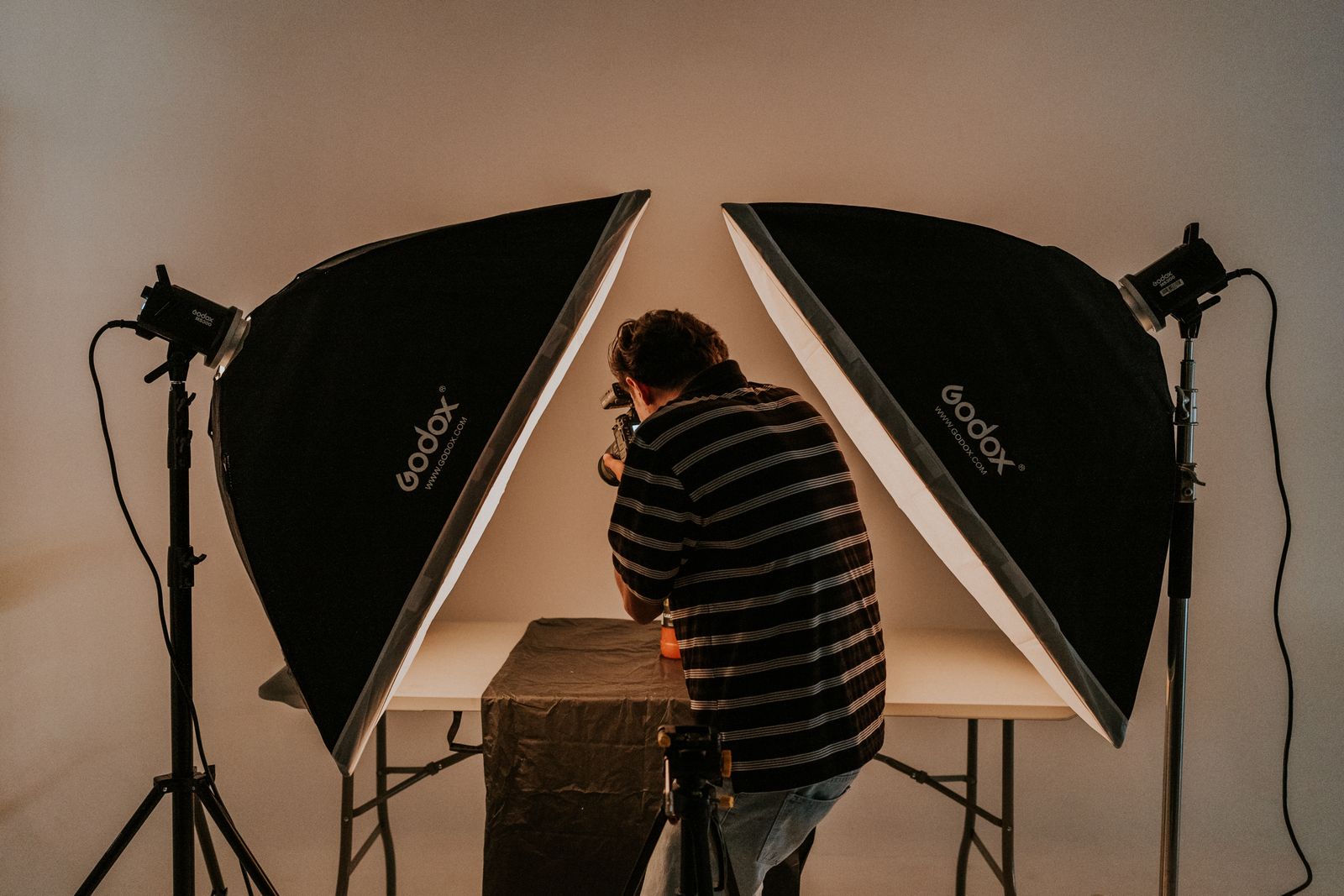
Photos: studio shoot — photo by Amar Preciado, https://www.pexels.com/photo/17094508/ ; camera on tripod — photo by Amar Preciado, https://www.pexels.com/photo/8389706/ ; studio portrait of a woman — photo by Andrea Piacquadio, https://www.pexels.com/photo/774909/
More guides
- How to Find a Wedding Photographer: The Complete, Honest GuidePhotographers › Wedding Photographers
- How Much Does a Wedding Photographer Cost? Packages DecodedPhotographers › Wedding Photographers
- 10 Questions to Ask a Wedding Photographer Before You BookPhotographers › Wedding Photographers
- Wedding Photography Styles Explained: Documentary, Editorial, Traditional, Fine ArtPhotographers › Wedding Photographers
- Hiring a Wedding Photographer in California: Venue Light, Permits, and Price LevelsPhotographers › Wedding Photographers
- All Guides & ArticlesBrowse the full guides library