Photographers › Children Photographers
Children Photographers for Small Businesses: What Changes When It Is Not Personal
When a family hires a children's photographer, the transaction is simple in structure even when the toddler is not: a session fee, a gallery, prints and files for the family's own walls and feeds, and a personal-use license that everyone understands without reading it. When a small business hires the same photographer — a daycare chain refreshing its website, a children's clothing brand shooting a catalog, a pediatric dentist who wants real patients on the homepage, a preschool buying picture day — almost every term changes meaning. The fee buys different things. The paperwork stops being a formality and becomes the product. And the risks move from disappointment to liability.
This site lists 375 children photographers. Most of them work both sides of this line. If you are booking one for a business for the first time, here is what actually changes — organized by the four places first-time business clients get surprised: who pays, what rights you receive, whose permission you need, and how the day itself runs.

Who pays flips — and so does the business model
The largest children's-photography sector is volume work for schools and daycares, and its economics invert the family model completely. In the standard picture-day arrangement, the school pays nothing. One working studio's published terms state it plainly: no monetary investment from the school, typically a one-to-three-year exclusivity agreement, and the operation sustained by parent sales — prints starting around $25, digital downloads with a print release around $65, packages from $35. The photographer is not really the school's vendor; the school is the photographer's distribution channel, granting access to hundreds of families on a predictable calendar.
That model scales to an almost industrial degree. The largest school photography company photographs roughly 30 million children a year across some 50,000 schools and childcare centers, at a pace where a fast shooter moves through hundreds of children in a day. Volume pricing guides describe the arithmetic honestly: individual families spend $20 to $40, margins are thin per child, and the profit lives in multiplying small margins across hundreds of subjects — a five-dollar rise in average order value is worth $2,000 on a 400-child job.
For a school or daycare director, the questions that matter are therefore not the family's questions. Not "how much?" — it costs you nothing — but: What do parents pay, in total, including the download fee? What does the exclusivity clause lock us out of, and for how long? Who handles parent complaints about pricing, us or you? What do we receive — yearbook files, staff portraits, marketing images — and under what license? A picture-day contract is a revenue-sharing and reputation arrangement wearing a photography costume. Read it as one.
Brand and marketing work flips the payment back: the business pays, and pays for a production, not a session. A real advertising job with children, preserved in the American Society of Media Photographers' paperwork archive, shows the anatomy: a photography and usage fee of $3,500 sat inside an estimated job total of $14,185, with casting, talent fees and a talent bonus, a props and wardrobe shopper, sets, makeup, an assistant, and project management itemized around it — including a third, backup child booked in case a young model had a meltdown on set. That is an agency-level example, but the structure scales down intact to a local clothing brand or toy shop: the photographer's fee is one line, and casting, releases, wardrobe, and contingency are the rest of the invoice.
The license is the product
In family work, the license is boilerplate — personal use, print your files, post them, done. In business work, the license is the thing you are actually buying, and it is priced separately from the shoot.
The baseline legal fact surprises many first-time business clients: paying for a photoshoot does not give you the copyright. Under US law the photographer owns the copyright in the images they create, unless they are your employee or have assigned the copyright to you in writing. What a business normally receives is a license — permission to use the images in defined ways. A clear license specifies the purpose (website, organic social, email, print ads, packaging), the territory, the duration, and whether sponsors, partners, or other brands may use the images too.
Working photographers price that ladder explicitly. One studio's published licensing page makes the structure typical: a standard license covering the business's own website and social channels is included; a digital advertising license — paid social and search ads, commercial website and email marketing — costs an additional 50 percent of the package price for twelve months; print and traditional advertising adds 75 percent; an extended commercial campaign license adds 100 percent for twenty-four months, with use outside the license invoiced at two to three times the applicable fee. Read those percentages as the market's shape rather than one studio's quirk: the same photograph costs more as it sells harder, and a campaign that outgrows its license — the website photo that becomes the packaging photo — is a new purchase, not a breach to apologize for later. Budget the use you actually plan for the next two years, not the use you can describe today.
For schools buying marketing photography rather than picture day, the same logic applies in a friendlier costume: one school-marketing photographer's published packages price a full school day of candid photography at $1,200 plus travel, producing as many as 500 images the school may use across websites, brochures, and viewbooks. The word to underline in any such offer is "use" — confirm it covers advertising, not just editorial display, before the shoot, not after the brochure is printed.
Permission: the part that can actually hurt you
Everything above is money. This section is risk, and it is the deepest difference between personal and business children's photography.
A family photographing its own children needs no one's permission to hang the print. A business publishing a child's photograph to sell something needs a signed model release from a parent or legal guardian — minors cannot generally consent for themselves — covering the specific uses planned. Standard teaching on releases is blunt: for commercial and marketing use of portraits, obtain written releases in every state, and a proper release identifies the parties, describes the images and permitted uses, states the consideration, and covers duration and territory. Using a person's likeness in advertising without consent can violate their right of publicity, and with children the reputational exposure rides alongside the legal one.
Three practical consequences follow. First, releases are a line item, not an errand: one licensing page notes explicitly that photos of minors do not include a commercial model release, that the client is responsible for obtaining signed releases, and that the photographer can help — for an extra fee. Allocate that responsibility in the contract, by name. Second, real customers are not models. The pediatric practice that photographs actual patients in the waiting room, or the kids' salon that wants its own happy clients on Instagram, needs a guardian-signed release for every identifiable child, every time the use is commercial — and a system for honoring a family that later withdraws. Many businesses conclude, correctly, that casting models with agency releases is cheaper than administering consent from their own customer base. Third, institutions have their own layer: schools, sports leagues, and youth organizations commonly require parental consent forms and restrict how images may be shared, so a business shooting at a school event inherits the school's policy as well as its own obligations. Ask for the policy before the shoot day, and expect the photographer who works institutions regularly to ask you for it if you forget.
Background checks belong in this section too. A family photographer is invited into a home; a business photographer is placed in front of other people's children, under your brand. Schools and daycares should require — and good volume and school-marketing photographers advertise — background-checked photographers. Put it in the contract, along with the rule that a second adult from the institution is present during sessions. These are standard expectations in institutional work, and a photographer who finds them insulting is telling you something.

The day itself: shorter, staffed, and scheduled around children
Business shoots with children run on child time, and professional productions budget for it openly — the backup child talent in that advertising estimate is the famous example, but the everyday version is simpler: young children have a working window, often well under an hour of cheerful cooperation, and a commercial schedule built like an adult shoot will spend its best light waiting for a nap to end. Experienced children's photographers build the day backwards from the youngest child's window, shoot the hero images first, and keep a second set of hands — an assistant or wrangler whose only job is attention and safety — in the budget.
Volume days invert the problem: not one child's window but hundreds of children's throughput, a logistics operation of backdrops, tethered laptops, class-by-class flow, and administrative data attached to every portrait. When you evaluate a picture-day company, you are evaluating that machine — how they handle absent children and retakes, how galleries are delivered to parents, how long files are kept — at least as much as the portraits themselves.
| Family booking | Small-business booking | |
|---|---|---|
| Who pays | The family, for the session and products | Picture day: parents pay, the institution pays nothing and grants exclusivity. Brand/marketing: the business pays for a production |
| What you receive | Files and prints under a personal-use license | A defined commercial license — purpose, territory, duration; expanded uses cost 50–100% more on published ladders |
| Copyright | Stays with the photographer; rarely discussed | Stays with the photographer unless assigned in writing — paying the invoice does not transfer it |
| Permission | The family's own consent is the whole story | A guardian-signed model release for every identifiable child, per commercial use; institutional consent policies on top |
| Safeguarding | Informal trust | Background checks and a second-adult rule, in the contract |
| The day | One family's children, one window of cooperation | Cast talent with backups, or hundreds of children on a volume line |
Booking one for your business: the short protocol
- Decide which business you are: an institution selling access (picture day), or a brand buying images. The contracts share almost nothing.
- Write the uses down before you request quotes — website, ads, packaging, partners, two years or ten — and let photographers price the license you actually need.
- Put releases, background checks, and the second-adult rule in the contract, with a name responsible for each.
- Unbundle the quote: shoot fee, license fee, casting and talent, assistants, travel, products. The ASMP example's lesson is that the photography line was a quarter of the job.
- Ask who owns the files in five years, and what a license renewal or expansion costs. Campaigns outlive their paperwork; prices for both belong in the first contract, not the third email.
Do that, and the children's photographer you hire for your business stops being a family vendor with a bigger invoice and becomes what the job actually requires: a small production company that is good with children, rigorous with paper, and clear about what its photographs may be used to sell.
Sources
- American Society of Media Photographers, paperwork share: studio photography of children for advertising — photography and usage fee of $3,500 within an estimated job total of $14,185, itemizing casting, talent and a talent bonus for a backup child model, wardrobe and props, sets, and sales tax; licensed for unlimited print and web placement for two years, excluding television and billboards.
- Rizo Creativo, photo usage and advertising licenses — a standard license for the client's own website and social channels included; digital advertising at +50 percent of package price for 12 months, print and traditional advertising at +75 percent, extended commercial campaigns at +100 percent for 24 months; use outside the license invoiced at two to three times the applicable fee; commercial model releases for minors expressly not included and the client's responsibility.
- HSM University, portrait photography course on releases and photographing minors — minors cannot generally give legal consent, so a parent or guardian signs; written releases recommended for commercial use in every state; schools and youth organizations commonly require parental consent forms and restrict sharing.
- Sprintlaw, photography contracts for commercial use — paying for a shoot does not transfer copyright; businesses normally receive a license defined by purpose, territory, and duration, with assignment available in writing where full control is needed.
- Morris & Co. Photography, school photography FAQ — no monetary investment required from schools, a one-to-three-year exclusivity arrangement, operations sustained by parent sales; prints from $25, digital downloads $65, packages from $35.
- Fstoppers, the economics of school picture day — the largest school photography company photographs roughly 30 million children a year across about 50,000 schools and childcare centers, at a pace of hundreds of children per photographer per day.
- Zenfolio, pricing volume photography — individual family spending of $20 to $40 multiplied across hundreds of subjects; a $5 rise in average order value worth $2,000 on a 400-subject job.
- Steven Long Photography, school marketing photography — a full school day of candid marketing photography at $1,200 plus travel, producing up to 500 images for websites, brochures, and viewbooks, by a background-checked educator-photographer.
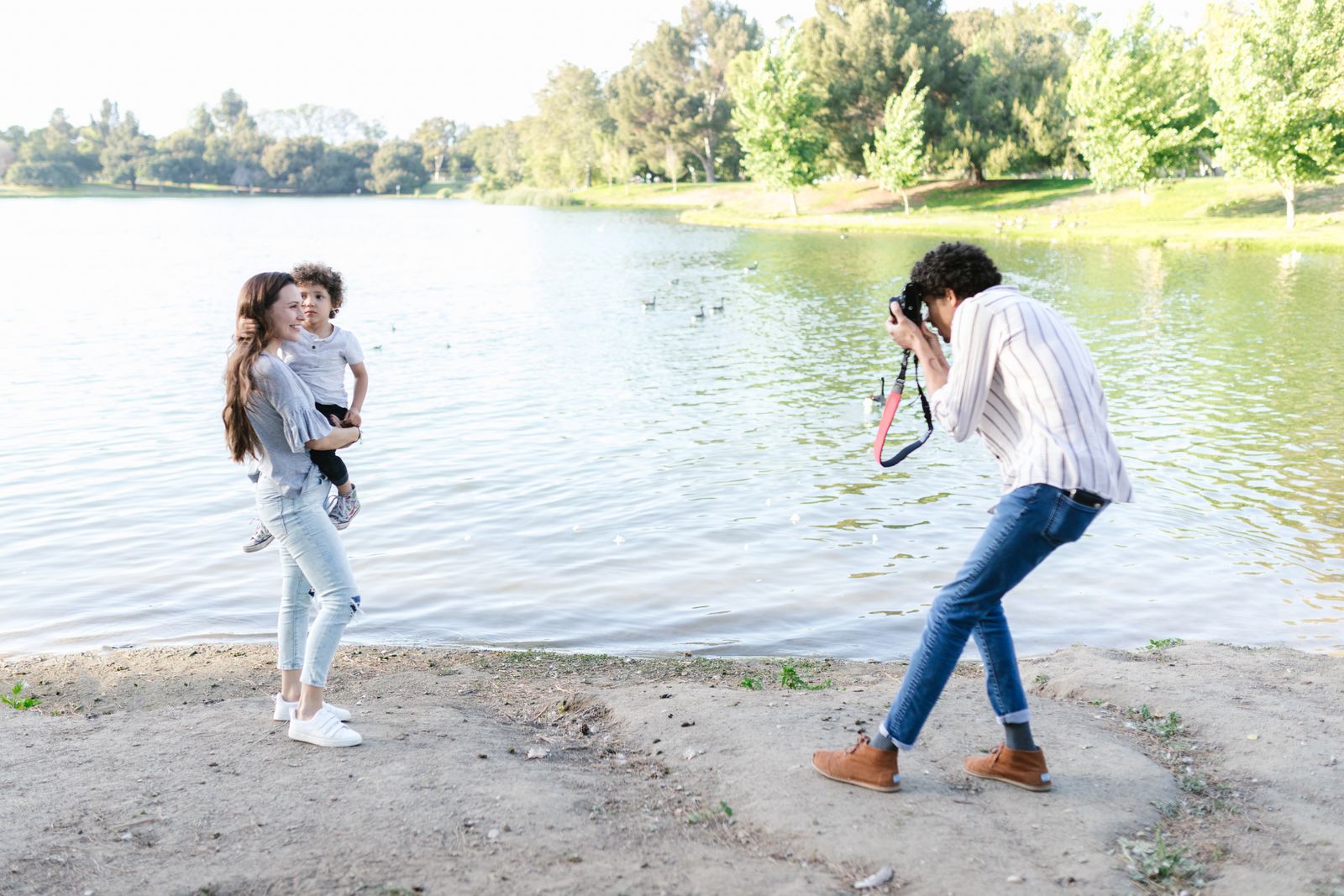
Photos: children playing in leaves — photo by Michael Morse, https://www.pexels.com/photo/1582736/ ; smiling toddler — photo by Alexander Dummer, https://www.pexels.com/photo/1912868/ ; family by a lake — photo by RDNE Stock project, https://www.pexels.com/photo/8208275/
More guides
- How to Find a Wedding Photographer: The Complete, Honest GuidePhotographers › Wedding Photographers
- How Much Does a Wedding Photographer Cost? Packages DecodedPhotographers › Wedding Photographers
- 10 Questions to Ask a Wedding Photographer Before You BookPhotographers › Wedding Photographers
- Wedding Photography Styles Explained: Documentary, Editorial, Traditional, Fine ArtPhotographers › Wedding Photographers
- Hiring a Wedding Photographer in California: Venue Light, Permits, and Price LevelsPhotographers › Wedding Photographers
- All Guides & ArticlesBrowse the full guides library