Photographers › Digital Imaging Photographers
Digital Imaging Photographers on a Tight Budget: Where to Save, and Where Saving Backfires
Digital imaging is the most price-transparent corner of photography and, paradoxically, the easiest place to waste money. The work — retouching, background removal, colour correction, compositing, scanning and restoring — is sold by the image, in published tiers, by hundreds of competing services. A simple cut-out can cost less than a cup of coffee's change. A complex one can cost more than lunch. And because the unit prices are so small, buyers stop doing the arithmetic that matters: volume multiplied by tier, plus revisions, plus the cost of the images that come back wrong and have to be done again by somebody else.
I assisted on commercial shoots where the imaging bill was a rounding error and on others where it quietly ate the profit. The difference was never the headline per-image price. It was whether the buyer saved on the things that are genuinely cheap to produce — standardised, high-volume, forgiving work — and refused to save on the things whose cheapness is a warning. This guide sorts one from the other, with the published prices that let you check my sorting against the market.
First, know what the work actually costs
Digital imaging is not one price; it is a ladder priced by complexity, and the ladder's rungs are published. Across current price lists and a comparison built from more than 170 editing providers, the shape is consistent:
| Task | Published per-image range | What moves it up the ladder |
|---|---|---|
| Background removal / simple clipping path | $0.20–$1.50 | Hair, fur, transparency, fine detail |
| Standard clipping path / colour correction | $0.39–$3.00 | Multiple objects, curves, grouped products |
| Ghost mannequin | $0.50–$7.00+ | Multiple source frames, complex garments |
| Product and portrait retouching | $0.50–$10 | Reflections, skin work, shadow rebuilding |
| Complex masking and advanced retouching | $3.50–$25+ | Jewellery, lace, glass, high-end beauty work |
| Photo restoration | $5–$50 | Damage extent — tears, fading, missing areas |
Two lessons hide in that table. The first is that complexity, not the service's logo, sets the price: a simple path on a smooth-edged product is a $0.33-to-$1.50 job at one published US guide's tiers, while a complex path on a bicycle or a lace garment starts around $3.99 and runs past $10, and super-complex work — fur, feathers, glass, smoke — reaches $8 to $20 and more in another pricing guide, because at that point it is masking and retouching, not path work. The second lesson is that "starting at" prices describe the simplest version of each task. Every honest list says so. Your images, not the list, determine your tier — which is why the first saving below is the most valuable one in this guide.
Where saving works
Save by testing before you commit volume. Reputable editing services offer free trials on your own images, and the trial is not a courtesy — it is the only reliable way to learn which tier your work actually falls into and whether a service's "standard" matches your standard. Send the hardest typical image you have, not the easiest: the product with the reflective surface, the garment with the lace. A service that handles your worst ordinary case at a fair tier will handle your catalogue. One that reclassifies everything as complex after the trial has told you its real price list.
Save by batching and standardising. Per-image prices fall with volume everywhere in this market — one scanning and imaging price list shows its 35mm rate stepping down from $0.45 an image at up to 2,000 images to $0.41 above 10,000, and editing providers structure the same logic into volume tiers and subscriptions. The buyer's half of that bargain is standardisation: consistent file naming, one specification for background, shadow and output size, images grouped by complexity so simple work is never billed at complex rates. Sloppy briefs are billed as complexity. Tidy briefs are billed as volume.
Save on scanning by matching resolution to purpose. Digitising follows the same ladder. Published bulk services run from about $0.29 an image after an initial batch at one large provider, through about $0.48 an image at another known for hand colour-correction, to a local service scanning loose prints at $0.25 each including both sides at 600 DPI, slides and negatives at $0.75 a frame. Meanwhile a detailed price list charges $0.45 for a small print at 300 DPI and $0.95 at 600, rising steeply with print size. The saving is not choosing the cheapest scanner. It is refusing to buy resolution you will never use: screen-and-reprint-at-original-size archives do not need the top tier, while negatives — the masters — justify scanning once at a high standard, because you will never want to pay to handle them twice.
Save with AI tools where a human checks the output. Current product-photography pricing research puts an AI-assisted listing image at roughly $5 per accepted image once review time is counted, against $30 to $50 for a studio white-background shot. For high-volume, low-stakes catalogue work — marketplace listings, internal references — that gap is real money, and the honest version of the workflow is in the phrase "accepted image": somebody reviews, rejects the failures, and only the survivors count. Budget the review, and the saving survives.
Save by cutting images, not quality. The cheapest edit is the one you never commission. Culling a 200-image shoot to the 40 that will actually be used before sending anything out is a saving with no quality cost at all, and it compounds: fewer images, at the right tier, with fewer revisions.
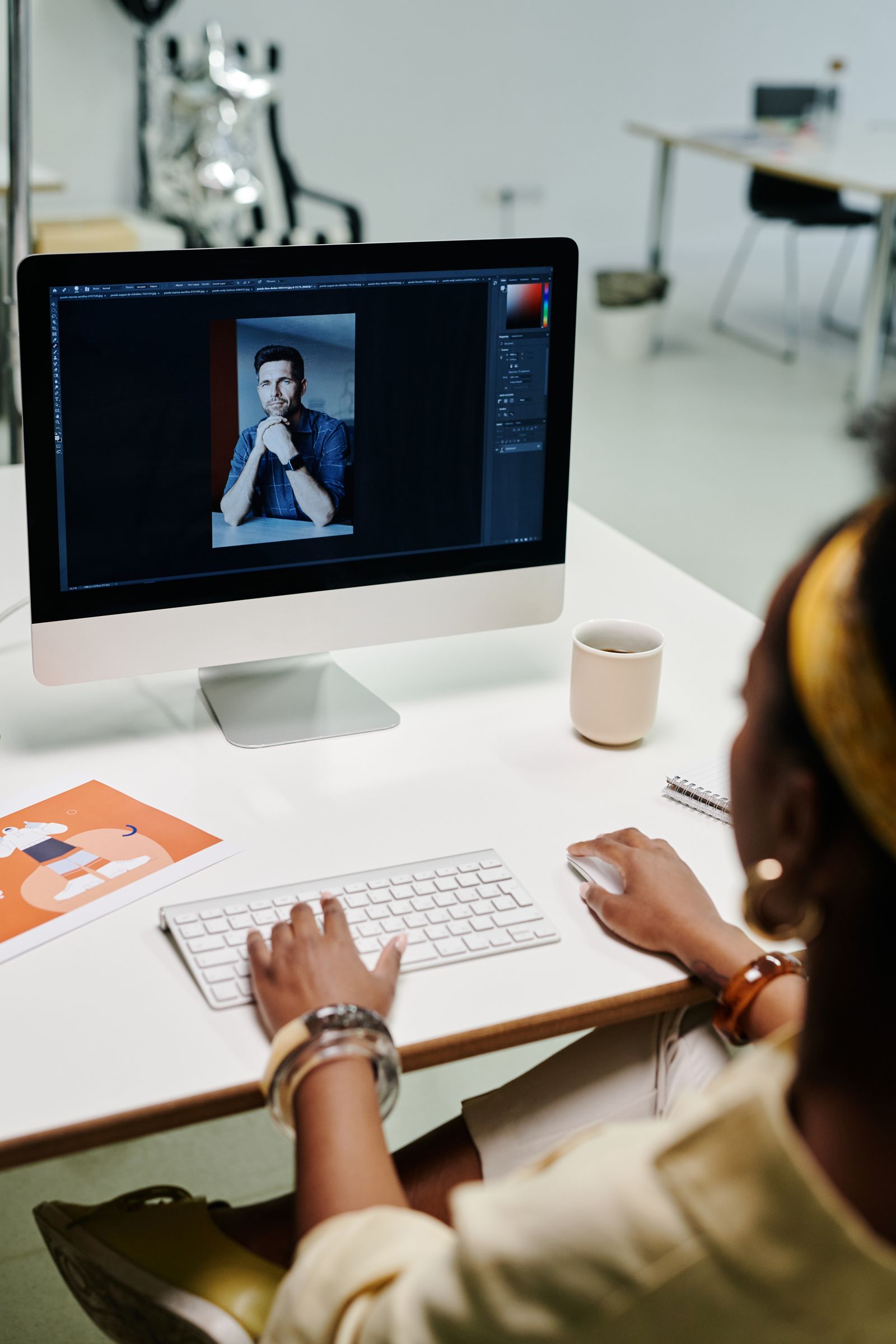
Save by choosing the pricing model that fits your rhythm. Providers sell this work four ways — per image, in volume tiers, by monthly subscription, and by the dedicated editor's hour — and the same business can overpay or underpay purely by standing in the wrong model. A seller with a steady weekly flow of similar product images is the subscription's natural customer: the effective per-image rate drops because the capacity is already bought. A business with one catalogue a season should stay per-image and harvest volume tiers twice a year instead of renting capacity it will not use in the months between. And a one-off archive project — the shoebox, the slide trays — should never become a subscription at all. Before comparing any two quotes, convert them to the same unit: total cost for your actual expected images, in your actual busiest and quietest months. Quotes that cannot survive that conversion were relying on you not doing it.
Where saving backfires
Skimping on the hero images. Every catalogue has a handful of images that do the selling: the lead product shot, the campaign frame, the cover. High-end retouching on jewellery and fashion starts near $10 an image and advanced work runs to $25 and beyond for a reason — reflections rebuilt, skin kept human, metal made to look like metal. Putting those frames through the cheapest tier does not produce slightly worse heroes. It produces images that look cheap at exactly the size and position where customers decide. Save on the 190 supporting images. Never on the 10 that carry the listing.
Choosing restoration by the floor price. Restoration is priced $5 to $50 an image in published lists because damage varies from a faded corner to a face half gone. The floor price buys the faded corner. A torn, water-damaged or incomplete family photograph sent to the cheapest service returns with the damage politely blurred rather than rebuilt, and the original problem is still yours — plus a fee paid. Worse, restoration works on a scan: if the scan was made cheaply at low resolution from a fragile original, the detail the restorer needed was never captured, and no skill downstream can invent it. With originals that are deteriorating, the sequence is the saving: scan once, well, then decide about restoration with the file in hand.
Sending originals to the cheapest pair of hands. Scanning prices differ by dimes; originals differ by irreplaceability. The published market includes services that hand-correct colour and process domestically and services whose reviews and ratings you should actually read before a shoebox of negatives goes into the mail. The backfire here is not a bad file. It is a lost box, a damaged strip, an album pried apart by a process that assumed prints would come loose. One bulk service's selling point is scanning album pages without removing prints at all — a reminder that handling method, not per-image price, is the specification that protects the only copies in existence.
Buying the wrong tier on purpose. It is tempting to describe complex work as simple and hope. Providers reclassify on sight — hair, transparency and jewellery announce themselves — so the gambit buys an argument, a delay and a requote, not a discount. The mirror-image mistake costs more quietly: paying complex rates for simple work because a brief never separated the catalogue into tiers. Both errors are brief failures, and both are fixed by the free trial and a written tier definition, agreed on sample images, before volume moves.
Saving on revisions and file specifications. The cheapest quotes assume you accept the first pass and take delivery in the provider's default format. If your use needs layered files, specific colour profiles, print-resolution masters or a revision round, an unspoken assumption becomes a second order. State the output specification — size, format, colour space, naming — in the brief, and price the revision policy before you need it. In imaging, the redo is the budget item; everything priced to avoid it is a saving, and everything priced by omitting it is a loan.
A tight budget, spent in the right order
If the money is fixed, spend it in this sequence. First, cull ruthlessly — free. Second, trial two services on your hardest typical images and fix the tier in writing — free, and it disciplines every price that follows. Third, batch and standardise the bulk work at volume rates, using AI assistance with human review where the stakes are low. Fourth, protect the irreplaceable: originals handled by a method you have verified, scanned once at a resolution matched to their future, not their present. Fifth, spend what remains where it shows: the hero images, the damaged photograph that matters, the complex work done by hands that charge for complexity because they can do it.
This site lists 354 digital imaging photographers, alongside thousands more in retouching and restoration — a deep enough market that no buyer has to accept the first price or the cheapest one. The tight budget is not the problem. The unexamined one is.
Sources
- Retouching Zone, Clipping Path Cost in the USA 2026 — simple paths from $0.33, standard from $0.39 and complex from $3.99 per image, with 24-hour turnaround tiers.
- Retouching Zone, Outsourcing Photo Editing Services Cost Comparison 2026 — a comparison of more than 170 providers: background removal $0.30–$3.50, clipping path $0.25–$12+, ghost mannequin $0.50–$7+, colour correction $0.30–$10+ by complexity.
- Graphic Design Eye, Clipping Path Pricing Guide — simple $0.50–$1.00, medium $1.00–$2.50, complex $3.00–$5.00, and super-complex masking work at $8–$20+ for hair, fur, glass and transparency.
- Pro Photoshop Expert, Photo Editing Cost Per Image 2026 — general editing from $2, manipulation and restoration at $5–$50 by complexity, clipping path $0.20–$5.
- Lars Miller Media, Product Photography Retouching — outside editing houses from $0.25 for a shadow and $0.39 for a clipping path to $10+ for high-end jewellery and fashion retouching.
- Capture, Cheapest Bulk Photo Scanning Services — bulk scanning from $19.99 for the first 50 photos then $0.29 each, ScanCafe at about $0.48 per image with restoration from $1.48, and kit-based pricing compared.
- Timeline Scan, Photo Scanning & Digitizing — loose prints at $0.25 each scanned both sides at 600 DPI, album photos $0.80, slides and 35mm negatives $0.75 per frame.
- Digital Conversions, Prices for Digitization Services — prints from $0.45 at 300 DPI and $0.95 at 600 DPI for small sizes, with volume discounts stepping a 35mm rate from $0.45 down to $0.41 above 10,000 images.
- Visualizee, Product Photography Pricing 2026 — studio white-background images at $30–$50 from published lists against an AI route at about $5 per accepted listing image including review time.
Photo credits
- Retoucher at an editing desk — photo by Darlene Alderson, https://www.pexels.com/photo/7971616/
- Black-and-white prints on a table — photo by Pavel Danilyuk, https://www.pexels.com/photo/8057039/
More guides
- How to Find a Wedding Photographer: The Complete, Honest GuidePhotographers › Wedding Photographers
- How Much Does a Wedding Photographer Cost? Packages DecodedPhotographers › Wedding Photographers
- 10 Questions to Ask a Wedding Photographer Before You BookPhotographers › Wedding Photographers
- Wedding Photography Styles Explained: Documentary, Editorial, Traditional, Fine ArtPhotographers › Wedding Photographers
- Hiring a Wedding Photographer in California: Venue Light, Permits, and Price LevelsPhotographers › Wedding Photographers
- All Guides & ArticlesBrowse the full guides library