Photographers › Photographic Equipment Service & Repair
How to Choose a Camera Repair Shop (and Ship Your Gear Safely)
A broken camera presents its owner with a peculiar problem: the people qualified to judge the repair are the same people selling it. You cannot watch the diagnosis happen, you cannot easily verify that a shutter really is worn out, and the vocabulary — CLA, bench fee, overhaul — is used loosely enough that the same word can describe $60 of work in one shop and $300 in another. Choosing a repair shop is therefore less about finding the cheapest quote than about finding a process you can trust: a clear estimate before authorisation, honest talk about parts, a turnaround you can plan around, and a warranty standing behind the work. This guide gives you the price ladder, the questions that sort good shops from risky ones, and — because the best shop for an old camera is often three states away — a packing method that gets your gear there and back in the condition it left.
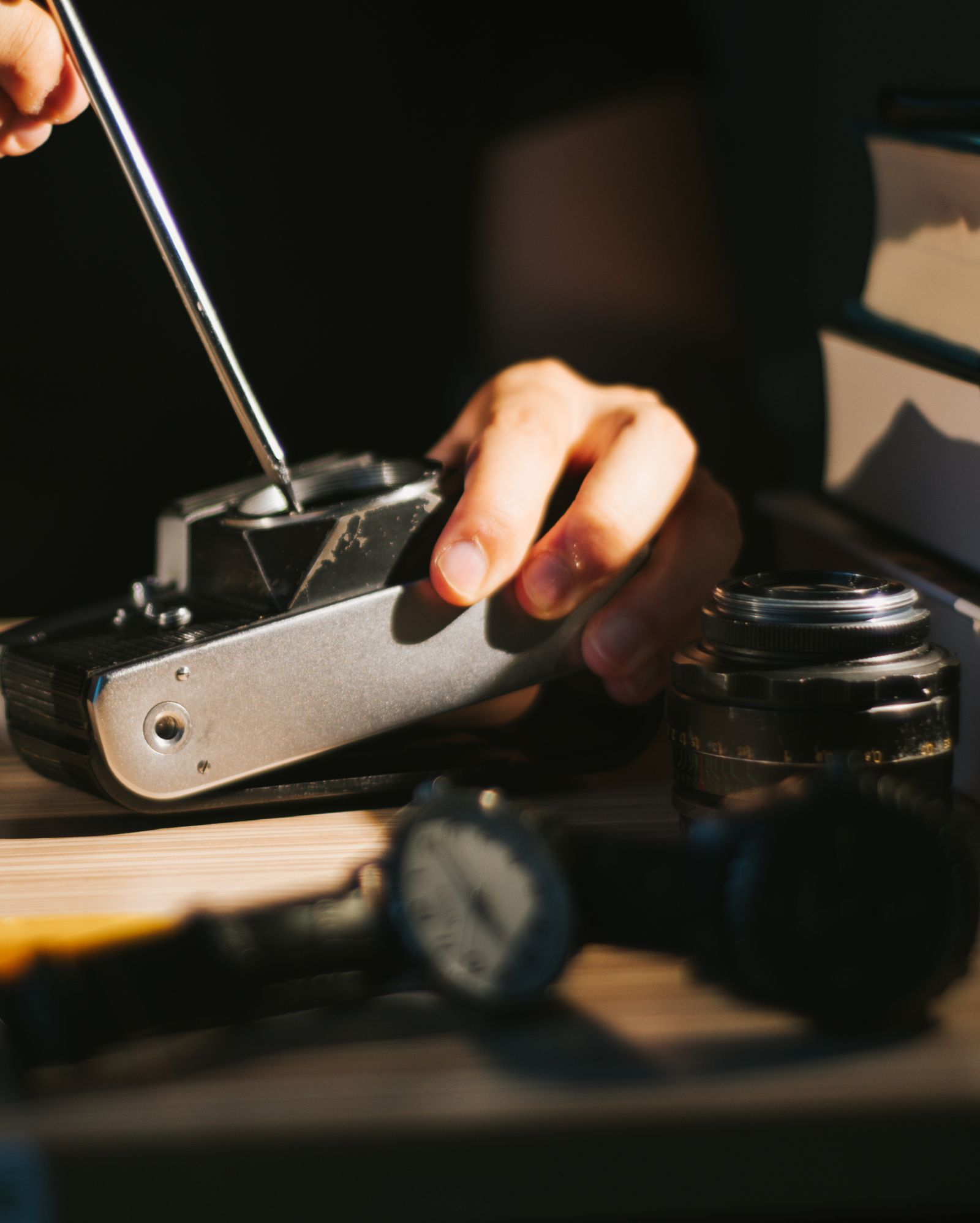
The three kinds of shop, and which one your camera needs
Manufacturer and authorised service is the right route for in-warranty work and for very new bodies whose parts are restricted to the maker's network. It is usually the most expensive route, and it has hard limits: manufacturers stop supplying spare parts a fixed number of years after a model is discontinued — commonly around seven to ten — after which an authorised centre will simply decline the job. Authorised service also has rules independents do not: Nikon, for example, will not service a grey-market import at any price, so if that is your camera, an independent is not the budget option, it is the only option.
Independent repair shops are the backbone of camera repair for everything else. Published comparisons put independents typically 20–40 percent cheaper than manufacturer service, turning work around faster, and — decisively for film shooters — willing to take bodies the manufacturers abandoned years ago, because a good independent keeps donor cameras to cannibalise for parts that no longer exist new. The trade-off is that quality varies shop by shop in a way a manufacturer's network does not, which is what the vetting questions below are for.
Camera stores with a repair counter are the option to interrogate hardest. Plenty of stores accept repairs at the counter and ship them to a regional service centre or the manufacturer, adding a handling markup and transit time at each end. That is exactly right for a warranty claim. It is a poor deal for an old mechanical camera, where the shipping and markup can approach the cost of the work itself. One question settles it: "Is there a technician in the building, or do you send it out?" It is a fact, not an opinion, and it changes both price and timeline — sending work out typically adds four to six weeks.
What repairs actually cost
Compiled from published repair price lists, the US ladder looks like this. Parts, shipping and specialist bodies are extra, and any shop should confirm its own figures in a written quote.
| Service | Typical US price | What is actually done |
|---|---|---|
| Bench / estimate fee | $24–$85 | Opening the camera, diagnosing the fault, quoting the repair |
| Clean and check | $25–$58 | External and accessible clean, function test, shutter-speed check |
| Sensor cleaning (digital) | $60–$120 | A wet clean of the sensor; the fix for recurring specks in skies |
| CLA (clean, lubricate, adjust) | $125–$325 | Strip, clean out old lubricant, re-lubricate, recalibrate shutter and meter |
| Full overhaul | $278–$378 | Complete teardown, every subsystem cleaned and rebuilt, worn parts replaced |
| Light seal replacement (film) | $40–$120 | New foam seals; the cure for light leaks and sticky residue |
| Digital shutter replacement | $200–$500+ | Parts-driven; quotable while the part exists |
| Lens mechanical repair | $100–$400+ | Aperture, focus and mount work; a lens CLA runs about $125–$165 |
Use the ladder diagnostically. A quote far below it for the same named job usually means the job is not the same: a "CLA" that is really a clean-and-check, an overhaul that excludes parts. A quote far above it is not automatically a rip-off — rare bodies, scarce parts and a senior technician all cost — but it should come with an explanation you can repeat back. And on anything over $200, get two quotes. Shops sit all across the published range for identical work; the overhaul band alone runs $278–$378.
Authorisation: the conversation that protects you
The bench fee is the first thing to ask about, before the camera leaves your hands. Almost every shop charges $24–$85 simply to open the camera, find the fault and quote the fix. The question is whether that fee is credited against the repair if you proceed — a swing of up to $85 on the same job — and what declining costs you. Declining is sometimes not free either: one major reseller charges $100 for a declined re-estimate. Know both numbers in advance.
Then set your authorisation limit in writing. The pattern to require is: diagnose, quote, and do not proceed past a stated figure — many owners use the estimate itself, or a round cap like $150 — without contacting me. Without that sentence, "we found two more things while we were in there" becomes a bill you have already incurred. Sometimes the two more things are real; cameras do hide secondary faults. The limit is not about distrust. It is about keeping the decision yours, made with the camera's value in view: a $350 overhaul is rational for a body worth $800 and sentimental nonsense, or perfect sense, for one worth $200 and your grandfather's initials inside the film door. Only you can weigh the second kind of value, and only if you are asked.
Ask about parts sourcing with the same directness. Is the part new, manufacturer-supplied, donor-harvested, or fabricated? For current cameras, new is normal. For discontinued ones, a donor part from a reputable shop is not a compromise — it is frequently the only supply that exists, and a technician who explains that plainly is showing you their honesty, not their weakness. What should worry you is vagueness: no answer on where a major part comes from, or a turnaround promise that ignores a part that has to cross an ocean.
Finally, the warranty. Ask how long the repair itself is guaranteed and what the guarantee covers — the specific fault, the assembly worked on, or the whole camera. Get it on the invoice. A shop that warranties its work in writing is telling you how it expects the story to end.
Turnaround, without the fantasy
Two to four weeks is normal at an independent shop; busy periods run longer, and a shop that sends work out adds four to six weeks on top. Repairs requiring ordered parts take longer again, especially for vintage and discontinued models. Treat a precise promise ("back Thursday week") from a shop that has not yet opened your camera as marketing. What you want instead is a current backlog figure, a timeline given with the estimate before work begins, and a shop that communicates when a parts wait changes the date. Counted properly, turnaround for mail-in work also includes transit both ways — another reason the in-house question matters.
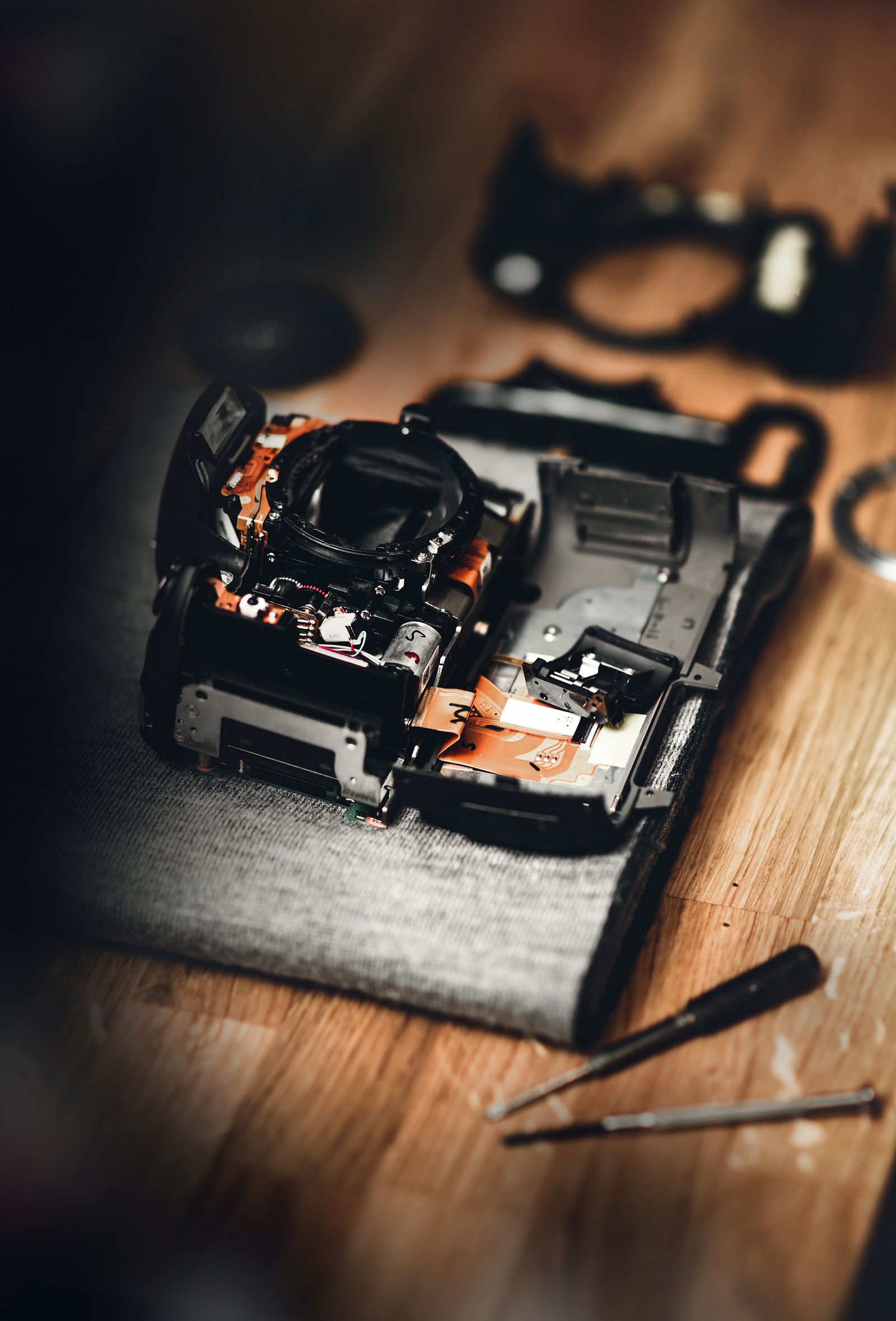
Shipping your gear safely
The best technician for a 1970s mechanical body may be a mail-in specialist states away — good shops explicitly welcome shipped work from across the country — so packing is part of choosing well. Do it in this order.
Before the box: confirm the shop wants the camera, and how. Some mail-in services ask you to contact them for the current shipping address and instructions before sending anything; follow their instructions over any general guide, including this one, where they differ — including the battery question below. Note the serial numbers of body and lens. Photograph the camera from all angles, as your condition record. Back up and remove your memory cards, and keep straps, grips and accessories at home unless they are part of the fault: everything extra in the box is something extra that can be lost, and shops specifically ask you to leave lenses, cards and straps behind unless a lens is being calibrated or repaired — in which case the body goes with each lens.
The battery exception: general shipping advice says remove batteries, but repair is different — at least one established mail-in service instructs customers to leave a fully charged battery in the camera, because technicians need power to run diagnostics, lock up a DSLR mirror and take test shots. This is why the shop's own instructions govern: ask, then do what they said.
Packing: body cap on, lens removed and wrapped separately if it must travel, to avoid strain on the mount. Wrap the body in several layers of bubble wrap or foam. Use a sturdy — ideally double-walled — box with at least three inches of padding on every side, packed so nothing moves when you shake it. One experienced service specifically advises against packing peanuts: they shift in transit, generate static, and shed particles that can find their way into the body — the opposite of what a camera being sent for cleaning needs. A padded envelope is never adequate. Put a printed note inside, on top: your name, phone number, return address, and a complete description of the problem and the service requested.
Sending: use a tracked carrier, require a signature, and insure the package for its full replacement value — the few dollars of premium are the cheapest line in the whole repair. Keep the tracking number with your serial-number record. Expect return shipping to be added to your invoice, commonly at the same carrier and service level you used to send it.
The shortlist test
A shop earns your camera by answering five questions without flinching: Is the work done in-house? What is the bench fee, and is it credited? What is your current backlog, honestly? Where will the parts come from? What warranty, in writing, covers the repair? This site lists 571 photographic equipment service and repair listings alongside 465 camera and supplies listings, so you will not lack for candidates. You will lack for time if you choose badly — a camera can spend two months in the wrong shop and come back unopened. Choose the process, and the repair usually follows.
Sources
- CameraStores.net, "Camera Repair Costs — What a CLA, Overhaul and Bench Fee Really Run" — bench fee $24–$85; clean and check $25–$58; CLA $125–$325; full overhaul $278–$378; parts supply ending ~7–10 years after discontinuation; in-house vs sent-out distinction, https://www.camerastores.net/guides/camera-repair-cost/
- Clean Camera, "How Much Does It Cost to Repair an Old Camera and Lens" — light seals $40–$100; film CLA $150–$350+; sensor cleaning $60–$120; digital shutter replacement $200–$500+; lens repair $100–$400+, https://www.cleancamera.com/post/how-much-does-it-cost-to-repair-an-old-camera
- CameraStores.net, Miami camera repair guide — independents typically 20–40% cheaper than manufacturer service; sent-out work adding 4–6 weeks; 2–4 week normal turnaround; grey-market service refusal, https://www.camerastores.net/camera-repair/florida/miami/
- Clean Camera, "Camera Repair & Sensor Cleaning Turnaround Times" and mail-in packing instructions — sturdy box, at least 3 inches of padding, nothing moving when shaken; charged battery left in; tracked, signed, insured shipping, https://www.cleancamera.com/post/camera-repair-turnaround-time-faqs
- Clean Camera, "How To Ship Your Camera For Professional Sensor Cleaning" — pre-shipment photographs and serial numbers; double-walled box; bubble wrap over packing peanuts; paperwork inside the box, https://www.cleancamera.com/post/how-to-ship-your-camera-for-professional-sensor-cleaning
- HowToShip, "Guide to Packing and Shipping a Camera" — at least three inches of packing material on all sides; a padded envelope is never adequate; insure for the product's value, https://howtoship.com/how-to-ship-a-camera/
- Hands repairing a vintage camera — photo by Ahmet Polat, https://www.pexels.com/photo/5587333/
- Disassembled camera on a workbench — photo by Alex Andrews, https://www.pexels.com/photo/821642/
More guides
- How to Find a Wedding Photographer: The Complete, Honest GuidePhotographers › Wedding Photographers
- How Much Does a Wedding Photographer Cost? Packages DecodedPhotographers › Wedding Photographers
- 10 Questions to Ask a Wedding Photographer Before You BookPhotographers › Wedding Photographers
- Wedding Photography Styles Explained: Documentary, Editorial, Traditional, Fine ArtPhotographers › Wedding Photographers
- Hiring a Wedding Photographer in California: Venue Light, Permits, and Price LevelsPhotographers › Wedding Photographers
- All Guides & ArticlesBrowse the full guides library