Photographers › Photo Restoration- Preservation- & Supplies
Photo Restoration and Preservation at Three Budgets: What Budget, Mid-Range and Premium Really Buy
In a commercial studio, the restoration jobs that arrived in envelopes were never really about nostalgia first. A seller had a founder photograph for a listing page. A maker had the only picture of a product line her grandfather built. A creator had a portrait that needed to work on a book cover, not just in a family album. The photograph had to convert — to convince a stranger, at thumbnail size, that something was real and worth trusting. That is a harder standard than “looks better,” and it is why the price of restoration spreads so widely.
The published market tells the story. Thumbtack’s cost guide puts an average restoration job at $78, typically $55 to $100, with a full range from $25 to $494. At the low end, online services start at $19 or $20 a photograph. At the high end, severe reconstruction runs $250 to $500 or more. This site lists 1,063 photo restoration, preservation and supplies businesses, and another 3,152 photo retouching and coloring businesses — so there is no shortage of sellers. The shortage is clarity about what each step up actually buys. Here it is, tier by tier.
The work underneath every tier
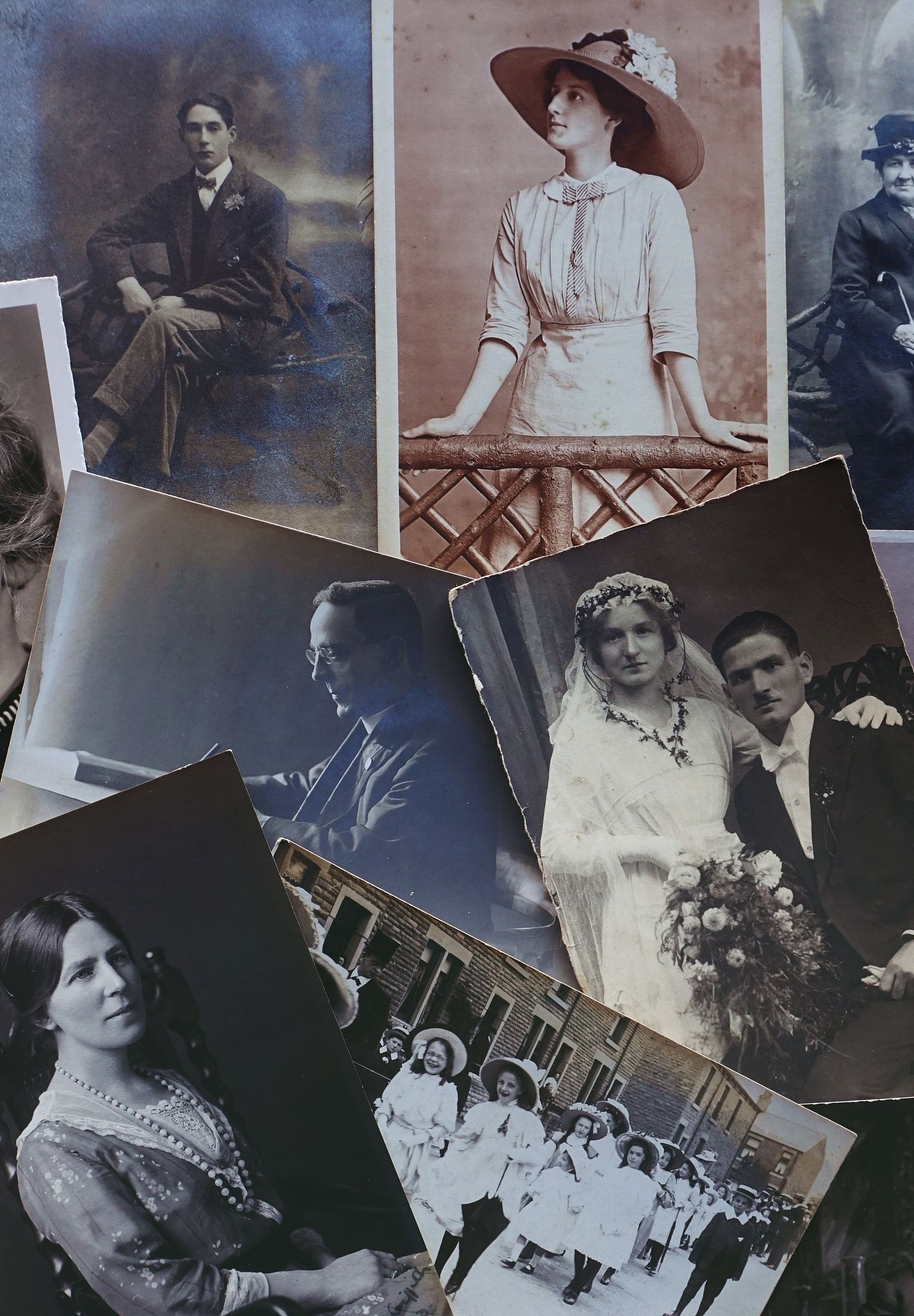
Every restoration, at any price, follows the same sequence. First the original is captured — scanned, usually, because restoration is now almost entirely digital work on a copy, not chemistry on the print itself. Then damage is repaired in order of scale: overall fading and color cast first, then cracks, tears and stains, then missing detail. Finally the restored file is delivered, printed, or both, and — in preservation work — the original and the file are stored so the job never has to be done again.
What changes between budgets is not the sequence. It is how much time a skilled person spends in the middle steps, how good the initial capture is, whether a face gets rebuilt by judgment or by a filter, and what you receive at the end: a JPEG for a screen, or an archive-quality file that can be printed large, cropped, and reused for years. Keep that frame in mind and the tiers stop looking arbitrary.
One fact governs all of it: restoration cannot invent information that was never captured. A completely blurred photograph cannot be sharpened back into focus — ScanCafe, to its credit, says so plainly and says it will tell you in the quote and not charge you if a photograph cannot be restored. Any service that promises otherwise at any budget is selling you a guess dressed as a recovery.
Budget: roughly $19 to $45 a photograph
Budget restoration is real work, within strict limits. RestoredPast lists a Quick Refresh at $19 a photograph: dust removal, color correction, minor blemishes. Its full restoration tier is $35. Vector Design US starts at $20 an image for light damage — dust and scratch cleanup, contrast and tone recovery, small spot removal, a print-ready export — and $30 for visible tears and stains, including crease repair and minor missing areas rebuilt. ScanCafe’s basic level runs from $3 to about $18 for small tears, marks and blemishes, and its medium level, $24 to $36, covers torn images and simple removal of a person or object.
What that buys, honestly: a faded snapshot that looks alive again on a phone screen. A product photograph from the 1990s cleaned enough for a listing. A portrait with the dust, the yellow cast and the scanner spots gone. For creators and sellers, this is often the commercially correct tier — most heritage images in a listing or an “our story” page are viewed small, briefly, and in competition with text. A clean, honest $25 restoration outperforms a $200 reconstruction at 800 pixels wide.
What it does not buy is judgment in difficult places. Budget work is fast work, increasingly assisted by automated tools — automated AI-only services run $5 to $15 a photograph in published guides, with the predictable warning about quality control. A tear through a plain background will vanish. A tear through a face, a hand, or a patterned fabric will be smoothed, averaged, or left — because fixing it properly means deciding what the missing part looked like, and that decision is the expensive part. Budget tiers also tend to deliver a finished JPEG, not a layered or archival master file, and revisions, if offered, are limited.
Volume changes the budget maths in your favor. RestoredPast drops its full restoration to $30 each at five photographs and $25 each at ten or more. If you have a set — a decade of shop photographs, a whole product archive — ask for the batch price before paying the single-image price ten times.
Mid-range: roughly $45 to $135 a photograph
Mid-range is where restoration becomes a craft service with a named human doing the work. Kubus Photo in Brooklyn prices basic restoration at $45, standard at $50 to $70, advanced at $75 to $95, and complex at $100 to $135 — with high-resolution 600-dpi scanning at $10 a photograph on top, and colorization at $75 a photograph. ScanCafe’s advanced tier, $48 to $60, is built for severe tears and advanced color fixes; its extreme tier starts near $97 for mold stains, heavy casts and recoloring a scene.
The step up buys three specific things. First, reconstruction. Missing corners, torn-off edges, a section eaten by water damage — mid-range work rebuilds them plausibly, extending backgrounds, clothing and architecture in a way that survives a second look. Second, faces. Detail refinement on eyes, skin and hair without the plastic smoothing that gives budget work away; for a portrait that will represent a person — a founder, an author, an artist — this is the tier where the photograph starts to be trustworthy again. Third, a better capture and a better file. Paying for the 600-dpi scan and receiving a file that can be printed at size, not just posted, is preservation and restoration in the same transaction.
This is also the tier where colorization lives, and it needs an honest label. Turning a black-and-white photograph into color is interpretation: the colors are chosen to look right, not recovered from the original, because the original never recorded them. Prices reflect that it is skilled guessing — $75 a photograph at Kubus, $25 to $100 or more on top of base restoration in the Fash guide compiled by Vector Design. For a seller, colorization can make a heritage image stop a scroll. Just never present a colorized photograph as if it were an original color record.
Premium: $150 to $500 and above
Premium restoration is reconstruction under uncertainty, priced by the hour whether or not the invoice says so. The Fash guide puts advanced work — tears, heavy staining, background rebuilding — at $150 to $250 an image, and complex work — severe damage, missing sections, painted reconstruction — at $250 to $500 or more. Local studio hand work clusters in the same territory. What you are buying is an artist spending hours, sometimes days, on one image: rebuilding a missing half of a face from the surviving half, repainting a background that no longer exists, matching grain so the repair does not announce itself at print size.
Premium also buys process protections that matter for valuable originals: inspection before a firm quote, a fixed price agreed before work starts, proofing stages where you approve reconstruction choices, and delivery of an archive-quality TIFF rather than only a compressed file. One independent restorer’s model is instructive — restoration and colorization from $40 a photograph, but every project gets a fixed quote up front after inspection. At premium prices, that inspection-and-fixed-quote step is not a courtesy; it is the product. Refuse any premium quote given without seeing a high-resolution scan first.
When is premium worth it? For exactly one kind of job: the irreplaceable image that must work at large size or carry commercial weight — the only photograph of a business’s founder, printed for a flagship location; the portrait on a book jacket; the group photograph where three of the faces are damaged and all three people matter. Premium spent on an ordinary snapshot is waste. Premium withheld from a true keystone image is false economy, because every use of it for the next thirty years will carry the flaw.
Preservation: the half of the title people skip
Restoration fixes the past. Preservation is the cheaper discipline of not needing restoration again, and at every budget it follows the same published economics.
Bulk digitization clusters between 25 and 50 cents a print at 300 to 600 dpi — Southtree at 25 cents, Larsen Digital at 30 cents for 300 dpi and 50 cents for 600 dpi, ScanCafe at 48 cents, iMemories at 49 cents. Premium handling costs more: EverPresent charges 98 cents for the first 200 scans and 68 cents after, plus a $50 order fee. A prepaid box can cut the unit price hard — ScanMyPhotos’ box holds about 1,800 photographs for $400 at 300 dpi or $445 at 600 dpi, roughly 22 to 25 cents a print if you fill it.
Resolution is the preservation decision that cannot be revisited once an original is lost, damaged, or thrown away after scanning — which is why you should never throw originals away after scanning. Guidance in the digitization literature is consistent: 300 dpi at original size is the floor for reprints and screen use, 600 dpi is the safer archival default, and small originals need more. Save masters as lossless TIFF files, back them up in at least two locations, and scan the backs of prints that carry handwriting — a date or a name on the reverse is information no restoration can recover once it is separated from the image.
For sellers, preservation has a commercial edge: a properly scanned, named, backed-up archive is a content library. The photograph you preserved at 600 dpi today is the anniversary post, the press image, and the packaging insert you do not have to commission next year.
| Tier | Price per photograph | What it really buys | Best use |
|---|---|---|---|
| Budget | $19–$45 | Cleaning, fading and color correction, small tears; screen-ready file | Listings, social, “our story” pages viewed small |
| Mid-range | $45–$135 | Reconstruction of missing areas, careful face work, 600-dpi capture, print-capable file | Portraits that represent a person; images printed at size |
| Premium | $150–$500+ | Hours of painted reconstruction, proofing, fixed quote after inspection, archival TIFF | The one irreplaceable keystone image, used large or commercially |
Choosing, in one pass
Sort your photographs into three piles before you contact anyone — screen-only, print-and-represent, and irreplaceable. Match the piles to the tiers in that order: budget, mid-range, premium. Scan everything at preservation standard while you are at it, because the handling, not the repair, is the risky part for an original. This site lists 1,063 restoration and preservation businesses; get the quote after inspection, in writing, with the delivered file specified — format, resolution, and whether revisions are included. Do that, and the money follows the importance of the image, which is the only rule in this trade that never changes.
Sources
- Thumbtack cost guide, via Vector Design US — average restoration job $78, typical $55–$100, full range $25–$494.
- Vector Design US, Photo Restoration Services and Cost guide — tiers from $20 per image by damage level; Fash guide ranges for advanced and complex work and colorization.
- RestoredPast, Pricing — Quick Refresh $19, Full Restoration $35, Heirloom $59, and volume pricing at five and ten photographs.
- Kubus Photo, Photo Restoration — $45 basic to $100–$135 complex, 600-dpi scanning $10, colorization $75.
- ScanCafe, Photo Restoration — pricing by level from $3 to $96.79 and up; statement that a blurred photograph cannot be sharpened and unrestorable work is not charged.
- Memrico guide to photo digitization companies — per-print scanning prices, prepaid box pricing, and premium handling fees.
Photo credits: Old portraits — photo by Suzy Hazelwood, https://www.pexels.com/photo/old-photos-3617531/ . Album pages — photo by cottonbro studio, https://www.pexels.com/photo/person-holding-baby-pictures-8848784/ . Classic camera in hand — photo by Sarah Trummer, https://www.pexels.com/photo/955794/ .
More guides
- How to Find a Wedding Photographer: The Complete, Honest GuidePhotographers › Wedding Photographers
- How Much Does a Wedding Photographer Cost? Packages DecodedPhotographers › Wedding Photographers
- 10 Questions to Ask a Wedding Photographer Before You BookPhotographers › Wedding Photographers
- Wedding Photography Styles Explained: Documentary, Editorial, Traditional, Fine ArtPhotographers › Wedding Photographers
- Hiring a Wedding Photographer in California: Venue Light, Permits, and Price LevelsPhotographers › Wedding Photographers
- All Guides & ArticlesBrowse the full guides library