Photographers › Photo Retouching & Coloring
Photo Retouching and Coloring Red Flags: The Warning Signs Most People Walk Straight Past
Retouching is the easiest photography service to buy badly, because you cannot judge it until after you have paid. The shoot, at least, happens in front of you. Retouching and coloring happen somewhere else, on copies of your pictures, by someone whose real skill you will only discover when the finished files come back — smoothed, shifted, or, in the worst cases, not returned at all. If you are booking a photographer for the first time, retouching is often folded into that first booking, quoted as a single reassuring line: editing included. That line is where most of the trouble hides.
This site lists 3,152 businesses under Photo Retouching & Coloring. The overwhelming majority are honest tradespeople doing detailed, unglamorous work well. But the category's low cost of entry — a laptop, a subscription, a confident website — makes it a comfortable home for the rushed, the automated, and the outright dishonest. Experienced buyers do not avoid bad retouchers by luck. They watch for specific warning signs, most of which appear before any money moves. Here they are, in the order you will meet them.
Red flag 1: The price is far below everyone else's, with no explanation
Price is the first sign, and the most walked-past, because a bargain feels like a win. So learn the shape of the real market first. Simple cut-out and clean-up work on straightforward product shots commonly runs about $0.40 to $2.00 an image in the United States market. Color correction matched to a reference across a set runs roughly $2 to $8 an image. Standard wedding retouching is typically $3 to $8 an image, with premium enhancement at $8 to $15. Hand retouching of portraits, beauty, and fashion work — the kind that preserves real skin texture — starts around $40 an image at a specialist studio, and high-end advertising, beauty, and jewelry work reaches $25 to $250 or more an image, because it takes hours per file, not minutes.
Against that landscape, certain offers indict themselves. A service offering detailed portrait retouching at under $1 an image is not efficient; it is telling you the work will be rushed, automated, or barely done. One widely used test in the trade: basic correction takes five to ten minutes an image even in practiced hands, and portrait work takes considerably longer. Arithmetic is a lie detector. If the price only works at ninety seconds a file, ninety seconds a file is what your photographs will get.
The opposite extreme deserves a question too, though a different one. A very high price is legitimate when the work is genuinely high-end — but the provider should be able to explain, in plain terms, what the hours consist of. "Premium" is not an explanation.
Red flag 2: No portfolio, or a portfolio that fails the zoom test
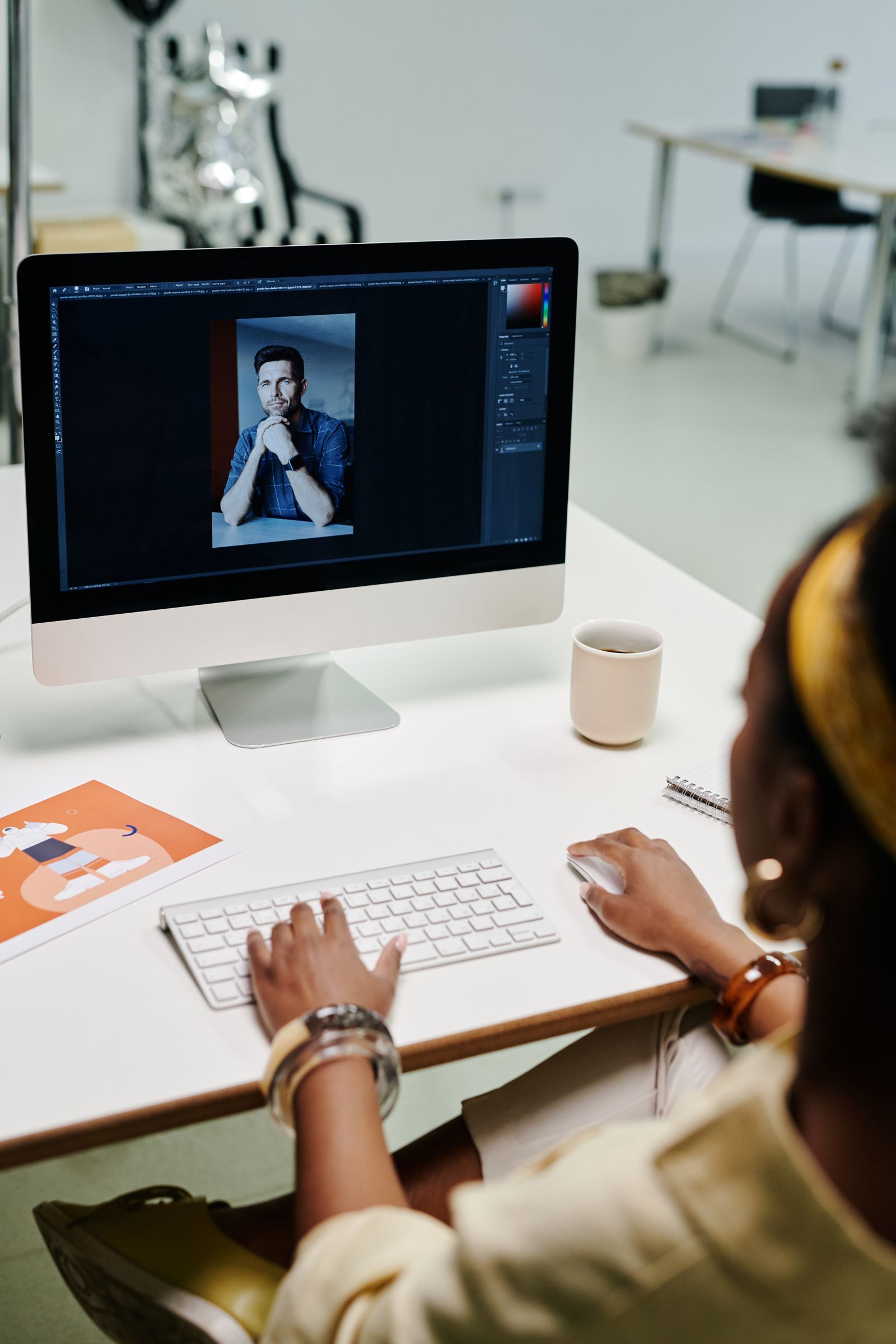
A legitimate service shows before-and-after examples. No portfolio at all is a red flag on its own — walk away — but the subtler version is a portfolio that only survives at thumbnail size. Retouching is a full-resolution craft. The failures live at 100 percent: skin smoothed into plastic, hair cut out with a visible halo, edges that dissolve, teeth whitened to a single flat shade, colors pushed into oversaturation. Ask for full-size examples, ideally in your kind of work — wedding, portrait, product — and zoom in.
Then look across the examples, not just at them. Do all the images look as though they went through the same filter? Cookie-cutter results, where every face has the same texture and every sky the same blue, signal a batch preset being sold as hand work. Good editing is customized to each image and each client; a portfolio with no variation is a production line introducing itself.
Red flag 3: Pressure to commit to a large order before a test
This is the sign experienced buyers treat as decisive. Legitimate providers let you test with a small batch first, because they are confident in the work. The standard safe test is five to ten images representing your different lighting conditions, subjects, and difficulty levels — not your easiest files, and not your hardest, but a fair sample. A service that pressures you to order a hundred images before any test, or that offers a bulk discount only if you commit today, is protecting itself from exactly the comparison a test would provide.
The same pressure wears other clothes: full payment demanded before any work is shown, a "today only" price on a service with no perishable inventory, or reluctance to discuss a small paid trial because "we don't work that way." Established retouchers do work that way. It is how their long-term clients started.
Red flag 4: No revision policy — or revisions priced as a penalty
Good services include revisions, because retouching involves judgment and judgment sometimes misses the client's taste on the first pass. The warning signs are a flat refusal to revise, a charge for every change however small, or — most revealing — a revision policy nobody can state clearly when asked directly. Before you send a single file, you should know: how many revision rounds are included, what counts as a revision versus a new instruction, and what an extra round costs. If those answers arrive as fog, expect the delivery to be take-it-or-leave-it, and expect any disagreement to be billed.
A related tell: the retoucher who says yes to everything without asking questions. Real retouching starts with questions — about output size, about how natural you want skin to stay, about color references, about deadlines. A provider who asks nothing is planning to give your images the standard treatment, whatever you asked for.
Red flag 5: Turnaround promises that break arithmetic
Quality wedding editing typically requires five to ten business days for standard orders, and reputable services that offer rush work charge a premium for it, because rush means reordering a queue and working longer days. Be wary, therefore, of both extremes of promise: the provider who guarantees an implausibly fast turnaround on detailed work at no extra cost — rushed work compromises quality, and the compromise will be visible on faces — and the provider who cannot state a turnaround at all. "A few days, probably" from someone holding the only copies of your wedding files is not a schedule. It is a hope, and you are the one underwriting it.
Get the delivery date, the delivery format, and the file specifications in writing: resolution, color space, file type, and whether layered or original files are returned. Vagueness about files — what you get back, at what size — is itself on the experienced buyer's list of red flags, because it is where a cheap service quietly becomes an unusable one. A gallery of small, heavily compressed files cannot be printed, cropped, or re-edited, whatever the screen preview suggested.
Red flag 6: Your photographs travel and live without protection
When you hire retouching, you hand a stranger copies of your most personal images — a wedding, a newborn, a family session. Professional services use encrypted transfer for upload and download and can tell you how files are stored and when they are deleted. Services that rely on unsecured email attachments or casual file-sharing links, and that go quiet when asked about privacy, are telling you how your pictures will be treated when something goes wrong. Ask two questions: how do I send files to you, and how long do you keep them? The answers cost a good provider nothing. That is the point.
For a first-time buyer there is a second, simpler protection: never send your only copy of anything. Retouching should always work on duplicates. If a service asks for originals — and for digital work there is never a technical reason to surrender your only copy — that request is a red flag all by itself.

Red flag 7: The coloring-specific traps
Coloring — colorizing black-and-white photographs and correcting or restyling color — carries its own set of warnings, because the buyer often cannot judge accuracy until they see the result, and sometimes not even then.
- Invented color presented as recovered color. Colorizing a black-and-white photograph is interpretation. Nobody can recover the true color of a 1948 dress from a grayscale print; an honest colorist says the result is a plausible rendering, discusses references with you — other photographs, family memory, period sources — and asks about skin tones, uniforms, and significant objects. A service that promises to restore the "original colors" exactly is promising something the information in the photograph does not contain.
- One flat rate for every condition. A clean studio portrait and a faded, damaged snapshot are different jobs. Coloring pricing that takes no account of the image's condition usually means the difficult files get the easy treatment.
- No proof stage. For a single treasured image, you should see and approve a proof — and be able to correct it: the hair was auburn, not brown; the car was blue. A service with no proof-and-correction stage on one-off family work is optimizing for throughput, not for your grandmother's hair.
What to do the moment a sign appears
One red flag is a question; two are a decision. The experienced buyer's sequence is simple. Stop before the large order, not after it. Run the small test batch — five to ten representative images — with any provider you have not used before, however good the website looks. Put the essentials in writing before files move: price per image or per hour, what the price includes, revision rounds, turnaround, delivery specifications, and file retention. Pay in stages where the order is large. And keep your own untouched copies of everything, always.
If a provider reacts badly to any of that — the test, the questions, the writing — you have learned the most important thing about them at the cheapest possible price. The good ones, all 3,152 listings' worth of honest competition on this site and beyond, will not react badly. They answer these questions every week, from buyers who ask them professionally. Ask like one.
A note on AI editing sold as hand retouching
One newer warning sign deserves its own paragraph, because first-time buyers meet it constantly and rarely recognise it. Automated and AI-assisted editing is now a legitimate part of the trade — it is fast at sorting, exposure correction, and consistent color across a large set, and honest providers say plainly where they use it. The red flag is not the tool. It is the disguise: batch-automated output sold, and priced, as individual hand retouching. The tells are the ones already covered — identical skin texture on every face, the same look applied to noon and candlelight alike, prices that only work at seconds per file — plus one more: a provider who will not answer, directly, what is done by a person and what is done by software. You are entitled to that answer, because the two products have different strengths. Software is consistent and quick; a skilled hand is what rescues the one difficult, important image — the only photograph of a grandparent, the frame where the light failed. Pay for the one you are actually receiving.
Sources
- HeroEdits, Outsource Photo Editing: When & How for Studios (2026) — retouching cost tiers by complexity, the five-to-ten-image test batch, and red flags including extremely low per-image pricing, no portfolio, no revision policy, pressure to commit to large orders upfront, and cookie-cutter results.
- LightHouse Retouch, Photo Retoucher for Hire — hand retouching starting at $40 or more per image for fashion, lifestyle, family and wedding work and $50 or more for portrait and beauty; red flags including no full-size examples, prices far below the market, and no clear answer on revisions or files.
- Wedding retouching service guidance, via Velog — standard wedding retouching at $3–$8 per image and premium enhancement at $8–$15, caution against services charging under $1 per image, standard processing of 5–10 business days, and encrypted file transfer as the professional norm.
- MediaScaleUp, How Much Does Photo Color Correction Cost? — United States market ranges of $0.40–$2.00 per image for simple cut-out and clean work, $2–$8 for color matched to a reference, and $25–$250 or more for high-end advertising, beauty and jewelry work.
Photographs: retoucher at a desk, photo by Darlene Alderson, https://www.pexels.com/photo/a-woman-using-a-computer-7971616/ ; editing desk, photo by Masood Aslami, https://www.pexels.com/photo/19177223/
More guides
- How to Find a Wedding Photographer: The Complete, Honest GuidePhotographers › Wedding Photographers
- How Much Does a Wedding Photographer Cost? Packages DecodedPhotographers › Wedding Photographers
- 10 Questions to Ask a Wedding Photographer Before You BookPhotographers › Wedding Photographers
- Wedding Photography Styles Explained: Documentary, Editorial, Traditional, Fine ArtPhotographers › Wedding Photographers
- Hiring a Wedding Photographer in California: Venue Light, Permits, and Price LevelsPhotographers › Wedding Photographers
- All Guides & ArticlesBrowse the full guides library