Photographers › Photo Retouching & Coloring
Photo Retouching Services: Rules, Licenses and Regulations, Explained in Plain English
The surprise usually arrives at the front desk, not in the contract. A couple loves their wedding portrait, asks the studio to remove an exit sign, slim nothing, change nothing else — and then asks for the layered file so a cousin can "keep working on it." Or a family sends a beloved portrait to an online retoucher, gets back a beautiful edit, and discovers the service's terms let that service use the before-and-after in its own advertising. Or someone pays a marketplace freelancer to retouch a photograph taken by a different photographer, and nobody in the chain ever asked whether they had the right to alter it at all.
None of this requires a villain. Retouching sits at the crossing of three different rulebooks — copyright law, consumer-protection and advertising law, and the ordinary law of contracts — and each one answers a different question. Who owns the picture? What may be done to it? What were you promised, and what can you prove? I managed a portrait studio long enough to watch all three get confused with each other, usually in the same conversation. This guide separates them, in plain English, so you can verify a retouching service before you pay one — which matters whether the photograph is your wedding portrait, your child's school picture, or the one family image everybody wants on the wall.
First, what counts as retouching
Retouching is not one job. In studio practice it falls into levels, and the level matters because price, turnaround and risk all rise with it. Basic work is correction: exposure, color balance, cropping, dust and spot removal. Standard retouching works on the subject — skin cleanup that keeps texture, stray hairs, teeth and eyes, minor distractions in clothing or background. Advanced work changes structure: compositing two frames, swapping a head from one group shot into another, rebuilding a background, removing a person. Restoration — repairing torn, faded or water-damaged prints — is its own specialty, often sold under the same "retouching" sign.
Published U.S. rate surveys put basic editing around $0.50–$3 per image, standard retouching around $3–$10, advanced work at $10–$40 and up, and high-end commercial finishing from $25 to well over $100 an image, with freelance hourly rates commonly $15–$50 or more. A price far below the floor of those ranges is not automatically a scam, but it tells you something real: the work is probably automated, batched, or both, and the careful human judgment you may be imagining is not in the budget.
Rulebook one: copyright — the photographer owns the picture
Under U.S. copyright law, the person who creates a photograph owns its copyright from the moment the work is fixed — saved to a card, a drive or a print. Payment does not change that. When you paid a photographer, you bought a service and, almost always, a license: a defined permission to use the images in specified ways. You did not buy the copyright itself unless a signed written agreement transferred it, or the work was genuinely made for hire — as an employee's work within a job, or in narrow commissioned categories covered by a signed agreement.
That single fact drives most retouching disputes, because the right to make derivative works — versions based on the original — belongs to the copyright owner. Retouching somebody else's photograph is, legally, making a derivative work. Three practical consequences follow.
Your own snapshots are yours to retouch. If you took the family photograph, you hold the copyright and may edit it, or hire anyone to edit it, as you please.
A professional's photograph needs the professional's permission to alter. Your wedding photographer's contract almost certainly addresses this — many prohibit third-party editing, or editing beyond what the studio itself offers, precisely because a bad edit with their name attached damages them. Sending their work to an outside retoucher without checking is the most common innocent breach I saw at the studio desk.
Routine retouching rarely gives the retoucher a copyright of their own. Copyright protects original creative contribution, not effort or expense. Color correction, cleanup and cropping are generally too routine to create a new copyright; a substantial composite or added original artwork might cross the line — and even then, the retoucher's rights sit on top of, and depend on, the photographer's underlying rights. A restoration that simply returns an old portrait to how it looked earns little or no new protection, which is good news for families restoring public-domain ancestors: the original stays free for everyone.
One newer wrinkle: work made entirely by AI gets no copyright in the U.S., because copyright requires a human author. A heavily AI-generated "retouch" may therefore be a picture nobody fully owns — another reason to ask a service, in writing, whether a human retoucher does the work and to keep the layered working files as a record.
Rulebook two: honesty — what the edited picture may claim
There is no U.S. law that bans retouching a portrait you commissioned of yourself. You may look as polished as you like in your own wedding album. The honesty rules bite when a photograph is used to sell something.
Section 5 of the FTC Act prohibits unfair or deceptive acts or practices in commerce, and federal false-advertising law (15 U.S.C. §§ 52, 55) reaches misleading claims in ads — including claims made by pictures. The FTC's Endorsement Guides (16 CFR Part 255, revised 2023) judge an ad by its overall impression, words and images together. The Guides' own example is instructive: pairing genuine acne testimonials with stock photographs of near-perfect skin misrepresents the result, even if every word is true. A before-and-after pair where lighting, makeup or retouching created the difference the product claims is misleading in the same way, and a fine-print disclaimer does not rescue it. Paid endorsements and material connections must be disclosed clearly and conspicuously.
For a family hiring a retoucher, this rulebook matters in a quieter place: the retoucher's own portfolio. The flawless before-and-afters on a service's website are its advertising. Ask whether the samples are the service's own work, whether the people pictured consented to be shown, and whether the "after" is retouching or a different photograph altogether. A service casual about honesty in its own marketing will be casual with your grandmother's portrait.
Privacy rides along here. A retouching service receives some of the most personal images a family owns. There is no special federal "retouching license," so protection comes from the service's privacy policy and your contract: how files are transferred, how long originals and edits are retained, whether images may be used for portfolio or training data, and how deletion is confirmed. If a service cannot answer those questions in writing, that is your answer.
Rulebook three: the contract — boring, decisive
Because no regulator licenses retouchers the way states license, say, cosmetologists or contractors, the consumer-protection weight falls on ordinary tools: the written agreement, payment records, and your state's general consumer-protection law against deceptive practices. That makes the paperwork the whole game. Before paying, get these points in writing — an email thread counts, a verbal promise at a studio desk does not:
- Scope, image by image. Which files, what level of retouching on each, and what is explicitly not being done. "Retouch the wedding photos" is how a couple ends up with skin smoothed on 400 frames when they wanted 12.
- The photographer's permission, where a professional took the pictures, and who is responsible for having it.
- File rights. What you receive (print-ready files? web files? the layered working file?), and what license you have to print, share and re-edit. Photographers and retouchers commonly withhold RAW and layered files unless the agreement says otherwise — negotiate it before, not after.
- Portfolio use. May the service display your before-and-afters, and can you say no without losing the service? Opt-out should be a checkbox, not an argument.
- Revisions and rejection. How many revision rounds are included, what counts as a new instruction (and a new fee), and what happens if the work simply is not good — refund, redo, or neither.
- Turnaround and delivery. A date, a delivery method, and how long the download link lives. Galleries and links expire; download and back up the day they arrive.
- Retention and deletion. How long the service keeps your files, and deletion on request confirmed in writing.
Payment hygiene is the enforcement mechanism you actually control: pay by a method with dispute rights rather than an irreversible transfer, keep the brief and approvals, and never hand over the only copy of anything. A studio or service that scans a family print should return the original by a tracked method — and you should scan a backup copy before it leaves your hands.

Red flags, from behind the studio desk
The services that caused my studio's clients grief shared habits. Prices quoted only after the files were uploaded and "assessed." No named human responsible for the work. Terms that granted the service a broad, perpetual license to use client images. Revision policies that counted the correction of their own errors against your rounds. Pressure to approve a low-resolution proof, with the full-resolution file released only after final payment and a review. And the classic: a portfolio of impossibly perfect faces that turned out to be stock imagery — the exact deception the FTC's guides describe, aimed at you.
Green flags are equally recognizable: published per-image pricing by level, a paid or free single-image trial before a batch, layered-file and license terms stated up front, a real privacy policy with retention periods, and a contract that mentions the photographer's copyright without being asked. This site's own directory is a reminder of the field's scale — it lists 3,152 businesses under Photo Retouching & Coloring alone — so there is never a reason to settle for a service that will not put the basics in writing.
A five-minute verification routine
Before you pay any retouching service, do these five things. Check the business exists beyond a marketplace profile — a real name, address and history. Read the terms for the three clauses that matter: file rights, portfolio use, retention and deletion. Confirm, if a professional took the photographs, that altering them is permitted. Order one image first, at the level you actually need, and judge the skin texture at full size — plastic skin at thumbnail size is plastic skin. And put the agreement, the brief and the delivery date in writing. Five minutes of that is worth more than any badge on a homepage, because in an unlicensed trade, your contract is the regulation.
That is the plain-English version: the photographer owns the picture, honesty rules govern what an edited picture may claim, and your written agreement governs almost everything else. Retouching itself is a wonderful service — it rescued more family photographs in my studio years than any other thing we sold. It just rewards the clients who read the three rulebooks before they hand over the files.
Sources
- U.S. Copyright Office guidance and Retouching Academy, "6 Copyright Facts Photographers and Retouchers Should Know" — copyright on creation, work made for hire, derivative works and AI authorship — https://retouchingacademy.com/photo-ai-copyright-2026/
- 35mm blog, "Photographers: Clear Usage Rights for Retouched Images and Source Files" — license versus ownership, and why routine edits rarely create a new copyright — https://blog.35milimetre.com/blog/usage-rights-for-retouched-images
- LegalClarity, "False Advertising in Makeup: What the Law Says" — FTC Act Section 5, 15 U.S.C. §§ 52 and 55, substantiation and digitally altered images — https://legalclarity.org/what-constitutes-false-advertising-in-makeup/
- FTC Endorsement Guides (16 CFR Part 255, revised 2023), as summarized in "Retouched Beauty Ads: US Ad Rules" — overall-impression test and the stock-photo testimonial example — https://doodlecovergirls.com/
- UniqRetouch, "Photo Retouching Rates in USA: Per-Image & Hourly Costs 2026" — basic $0.50–$3, standard $3–$10, advanced $10–$40+, high-end $25–$100+ per image — https://uniqretouch.com/photo-retouching-rates-usa/
- Aftershoot, "AI Photo Retouching vs Manual Retouching (Tested, 2026)" — outsourced retouching cost context, roughly $1–$150+ per image — https://aftershoot.com/blog/manual-vs-aftershoots-ai-retouching/
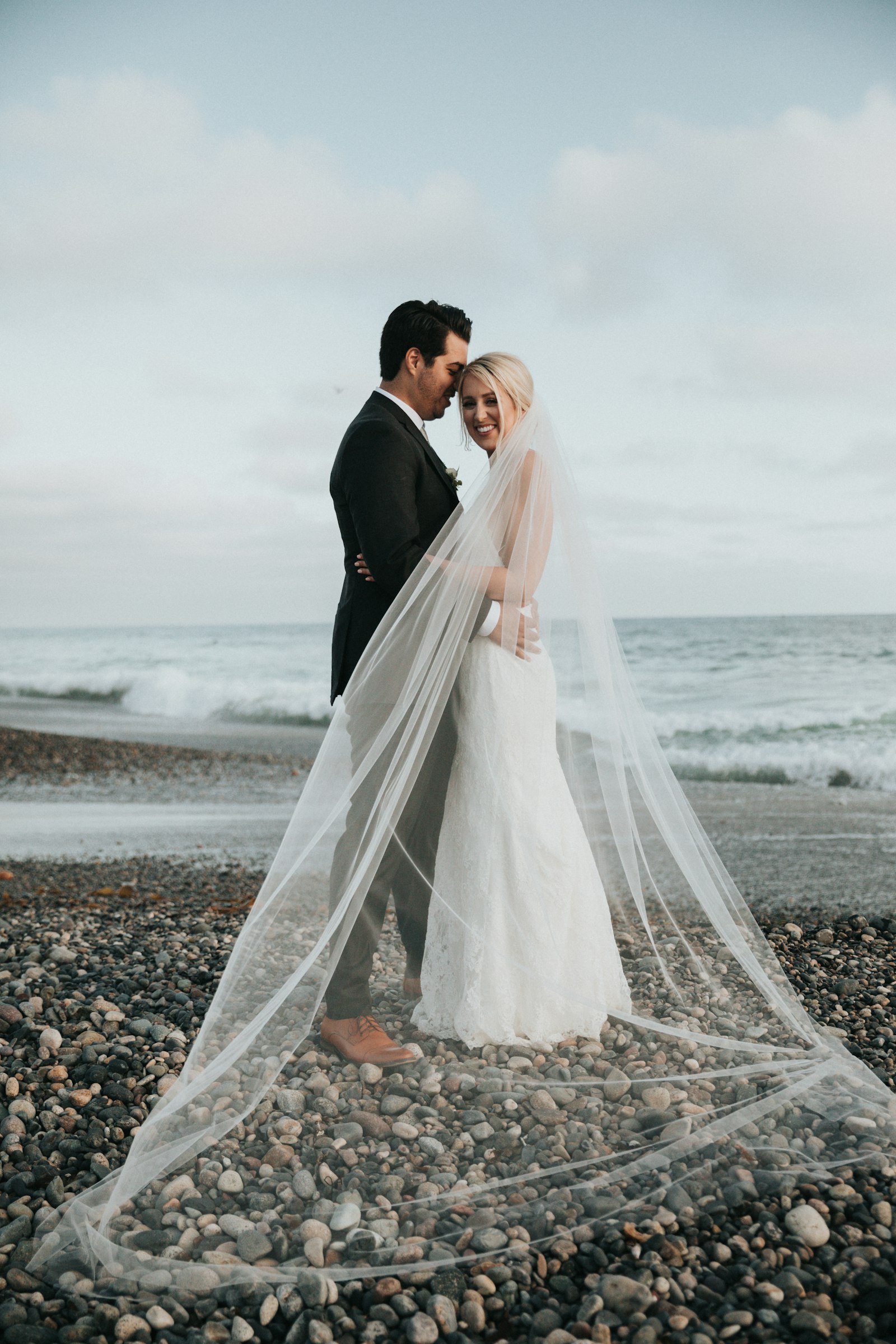
- Bride portrait — photo via Unsplash, https://images.unsplash.com/photo-1537633552985-df8429e8048b
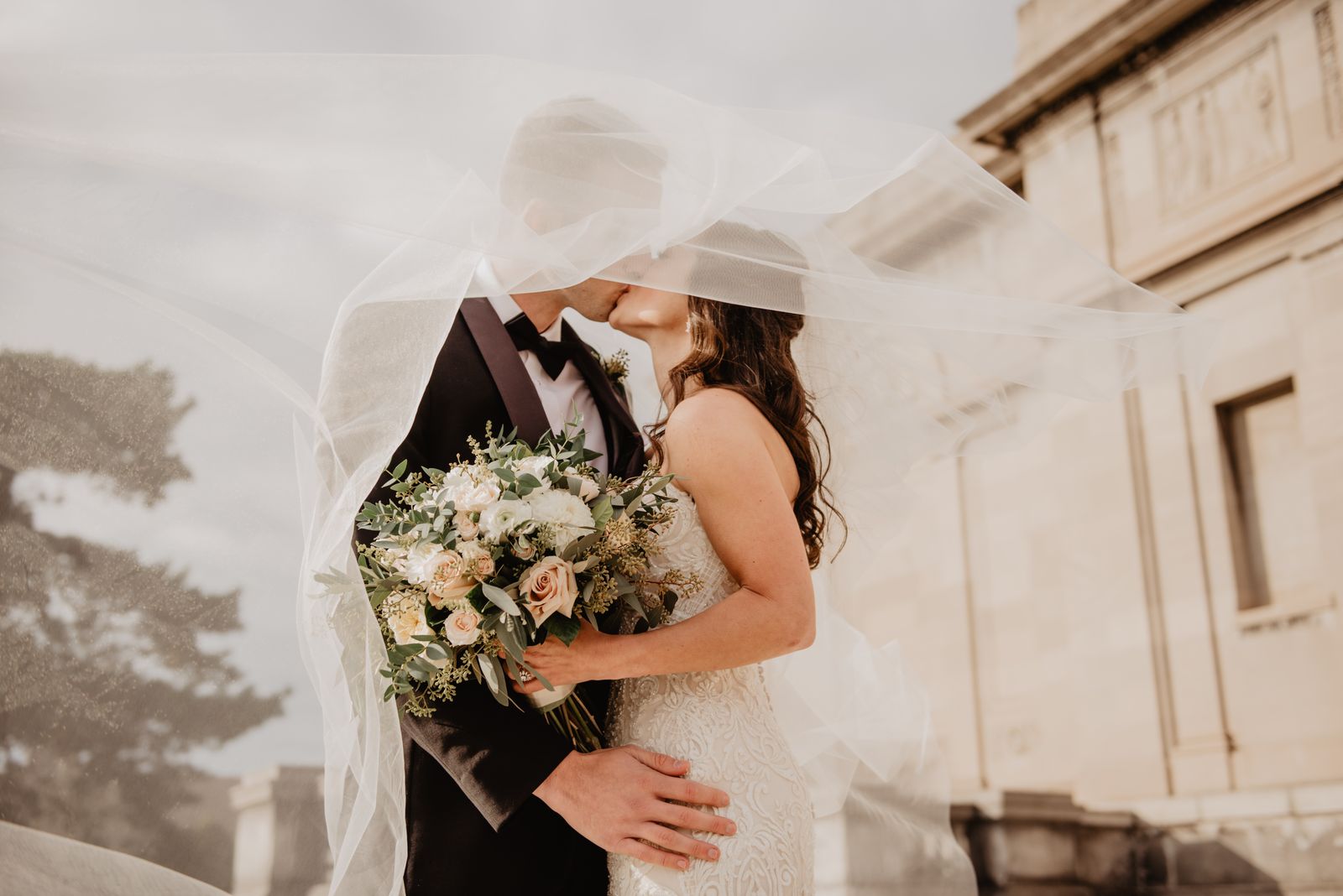
- Couple under a veil — photo by Pexels photo 2253870, https://www.pexels.com/photo/2253870/
- Bridal shoes and bouquet — photo by Pexels photo 313707, https://www.pexels.com/photo/313707/
More guides
- How to Find a Wedding Photographer: The Complete, Honest GuidePhotographers › Wedding Photographers
- How Much Does a Wedding Photographer Cost? Packages DecodedPhotographers › Wedding Photographers
- 10 Questions to Ask a Wedding Photographer Before You BookPhotographers › Wedding Photographers
- Wedding Photography Styles Explained: Documentary, Editorial, Traditional, Fine ArtPhotographers › Wedding Photographers
- Hiring a Wedding Photographer in California: Venue Light, Permits, and Price LevelsPhotographers › Wedding Photographers
- All Guides & ArticlesBrowse the full guides library