Photographers › Photographic Equipment Service & Repair
Photographic Equipment Service and Repair Jargon, Translated: The Terms Providers Use and What They Mean for Your Bill
A repair estimate is a short document with an unusual property: almost every noun in it is a term of art, and almost every term of art moves the total. "Needs a CLA" and "needs an overhaul" can describe the same camera at two shops and differ by two hundred dollars. "Fungus, cleaned if not etched" contains a whole prognosis inside a conditional. I spent my assisting years carrying gear to and from repair counters, translating estimates for the photographer I worked for, and the translation skill turned out to be the valuable one — because once you know what the words mean, you can hear what the bill will be before it is printed.
Here is the dialect, organized the way your estimate unfolds: the words at intake, the service words, the diagnosis words, and the verdict words. Prices are typical published U.S. ranges; your camera and your city will move them, but the meanings will not change.
The intake words: what you pay before anyone fixes anything
Bench fee (or estimate fee). The charge — typically $24 to $85 — for opening the equipment, diagnosing the fault and quoting the repair. Diagnosis is skilled work and the fee itself is fair. The question that matters is whether it is credited against the repair if you proceed. Two shops quoting the same $150 job are offering different deals if one credits its $60 bench fee and the other pockets it either way. And if you decline the repair at a non-crediting shop, you have paid $60 to be told your camera is not worth fixing. Ask before you hand the camera over, not after.
Clean and check. The shallow end of service: $25 to $58 buys an external and accessible-internal clean, a function test and a shutter-speed check, with no real disassembly. It is a health check, not a cure. If a shop recommends a clean and check, they are saying "nothing is obviously broken"; if your camera has an actual fault, a clean and check will find it and then hand you a second estimate for fixing it.
Turnaround language. "Minor repairs, parts in stock: two to three business days. Standard repairs with a parts order: two to three weeks. Factory service: four to six weeks." Those are one large repairer's published bands and they are typical. Learn to hear the hidden clause: any timeline quoted before diagnosis is a hope, and any timeline that depends on a parts order is a hostage to the parts system — which brings us to the verdict words, below.
The service words: CLA, tune-up, overhaul
CLA — clean, lubricate, adjust. The standard service for a mechanical camera or lens: strip the mechanism, remove old lubricant that has thickened into varnish, re-lubricate where the design calls for it, and recalibrate — shutter speeds back to specification, meter checked, rangefinder and focus aligned. Published prices run about $125 to $325 for a body (a common 35mm SLR sits at $225 to $325 at one film specialist, with a three-month warranty), and lenses are priced separately at roughly $125 to $330 — a body CLA does not touch your glass, a fact that surprises people on the invoice. A CLA is maintenance, not resurrection: it does not include replacing broken parts or repairing failed electronics, which are quoted as repairs on top.
Tune-up. Beware this word, because the trade uses it inconsistently: one major repairer states plainly that its "tune-up" — about $128 — is what other shops call a CLA, while elsewhere a tune-up means a lighter partial service. Same camera, same word, different depths of work. The translation rule: never compare service names between shops; compare the list of operations. Ask what is actually done — top cover off? shutter tested and adjusted? seals replaced? — and compare lists, not labels.
Overhaul. The full teardown: complete disassembly, every subsystem cleaned and rebuilt, worn parts replaced, full recalibration. One national repairer prices it at $278 to $378 plus parts, at six to eight weeks, noting the job takes a technician the better part of a day or more. An overhaul quote means the shop believes the equipment is worth rebuilding — or that you love it enough to pay for rebuilding. It is the most expensive word in the dialect that is still good news.
Light seals. The foam strips in a film camera's door channels that keep light out. They crumble with age into black goo, and replacing them is among the cheapest jobs on any menu — specific small repairs like seals, a stuck shutter or an unjam run $80 to $120 at the film specialist above, though without the warranty a CLA carries. If your only symptom is light leaks on film, this is the whole bill. Rejoice quietly.
The diagnosis words: what is actually wrong
Shutter actuations (shutter count). The total number of times a digital camera's shutter has fired — its mileage. Shutters are rated: roughly 50,000 to 100,000 actuations for entry bodies, 150,000 to 200,000 for mid-range, 300,000 to 500,000 for professional bodies, with many shutters outliving their ratings several times over. When a shop quotes a shutter replacement, compiled prices run about $150 to $250 at entry level, $250 to $400 mid-range and $350 to $500 for pro bodies. The bill implication: on a high-count body, ask whether the rest of the camera justifies a new shutter, because you are buying the camera a second life, not a tune-up.
Fungus. A web-like growth that colonizes lens elements in humid storage. Removal — disassembly and internal cleaning — is published at $78.50 to $228.50, toward the top for zooms. The conditional that matters is etched: fungus secretes acid, and left long enough it etches the lens coating permanently. "We can clean it" and "we can clean it but the etching will remain" are different outcomes at the same price; get the shop's honest read on which you are buying, because etched coating means a permanent, if sometimes mild, loss of contrast.
Haze. A foggy film on internal elements, often vaporized lubricant condensed on glass. Unlike fungus it has not eaten anything; cleaning usually restores the lens fully. Haze is the good diagnosis that sounds bad.
Separation. The cemented elements inside a lens coming unglued at the edges, visible as a silvery or rainbow fringe. Re-cementing is specialist work, sometimes possible, sometimes not economic. Separation is a word that often travels with the verdict words below.
Sticky aperture blades. Oil migrated from the focusing mechanism onto the aperture blades, making them slow or stuck. The lens comes apart, the blades are cleaned and the source addressed — a routine specialist job, and one of the classic causes of erratic exposures on old lenses. Related: a stiff focus ring usually means the helicoid — the focusing thread — has dried grease, which is a cleaning-and-relubrication job inside a lens CLA.
Sensor cleaning versus sensor anything-else. The dark specks that appear in skies at small apertures are almost always dust on the sensor's filter, fixed by a wet clean — cheap, quick, routine. Learn to separate that sentence from the expensive one: a scratched filter or a failing sensor is a parts replacement, priced like one. If an estimate for "sensor issues" does not say which of the two it is, ask.
Calibration, front-focus, back-focus. Autofocus that consistently misses in one direction. On many systems the fix is adjustment — sometimes a menu setting (AF microadjustment), sometimes bench calibration of body, lens or both. It is labor, not parts, and it should be priced like labor. If a shop wants to replace components for a consistent focus offset, get a second opinion.
PCB, main board, flex cable. The electronics words. A failed main board or a torn ribbon (flex) cable is where mechanical-era pricing ends: the part may cost more than the labor, may come only from the manufacturer, or may simply no longer exist. Which is the bridge to the verdicts.
The verdict words: where bills go to be decided
| Term | Translation | What it means for your bill |
|---|---|---|
| BER — beyond economical repair | The repair costs more than the equipment is worth | You pay the bench fee and take the camera home, or trade it as parts |
| NLA / no longer available | The manufacturer no longer supplies the part | The shop may offer a donor part or decline the job entirely |
| Donor body / cannibalize | A second, dead unit harvested for parts | You are buying two cameras to make one; price it that way |
| Gray market | Equipment imported outside official channels | Factory service centers may refuse it outright; independents become your only route |
| Authorized service | The manufacturer's own or franchised repair channel | Full parts access, factory pricing — independents commonly run 20–40% below it |
| Parts hold | Your repair waits in a queue for a component | The timeline is out of the shop's hands; ask what the fallback is |
BER deserves one more paragraph, because it is the verdict owners argue with. Shops apply rough heuristics — a common one weighs the repair against the equipment's replacement value and balks somewhere around half — but the honest version is arithmetic, not insult: when a $300 repair meets a camera that sells tested and working for $250, the shop is telling you the market's answer. Sentimental value is a legitimate override; owners of inherited cameras pay BER-defying bills every day, knowingly. The red flag is the opposite shop — the one that never says BER, and will happily take overhaul money for a camera worth less than the bench fee's big brother. A repairer who talks you out of a repair is a repairer to keep.
Gray market is the verdict that arrives before any diagnosis: factory-authorized centers can decline equipment that was imported outside their region's official distribution, however simple the fault. Independent shops — and this site lists 571 photographic equipment service and repair providers, alongside 47 camera service and repair specialists — exist in large part for the work the factory channel will not or cannot take: older bodies, orphaned brands, gray imports, and anything whose parts must come from a donor.
Reading your next estimate
Run any estimate through four questions. Is the bench fee credited? Is the service named by its operations, not just its label — and is the lens included, or only the body? For a diagnosis, is it the cleanable version of the problem (haze, dust, dried grease) or the permanent one (etching, separation, dead boards)? And has the shop said the verdict word if the verdict applies — because the most trustworthy sentence in the whole dialect is the one that costs the shop a job: this one is not worth repairing.
Sources
- CameraStores.net, "Camera Repair Costs — What a CLA, Overhaul and Bench Fee Really Run" — establishes bench fees of $24–$85, clean and check at $25–$58, CLA at $125–$325, overhaul at $278–$378, and the credited-versus-uncredited bench fee distinction.
- Precision Camera, in-house repairs price list — establishes fungus removal at $78.50–$228.50, zoom lens work at $128.50–$228.50, tune-up at about $128, overhaul at $278.50–$378.50 plus parts, and turnaround bands of 2–3 days, 2–3 weeks and 4–6 weeks.
- Brooklyn Film Camera, CLA and repair pricing guide — establishes body CLAs at $225–$325 with a three-month warranty, lens CLAs at $125–$330, specific small repairs at $80–$120, and that body and lens CLAs are separate services.
- Cameras Obscura, "Camera CLA Explained" — establishes what a CLA includes and excludes, and that a CLA is maintenance rather than parts replacement or electronics repair.
- BalanceMotive, camera auction terminology guide — establishes plain definitions of fungus, haze, CLA and shutter actuations.
-
Repair cost compilations from this programme's repair research (Click&Learn and PhotoWorkout via the repair field guide) — establish shutter ratings of 50,000–500,000 actuations by body class and shutter replacement at $150–$500 by tier.
-
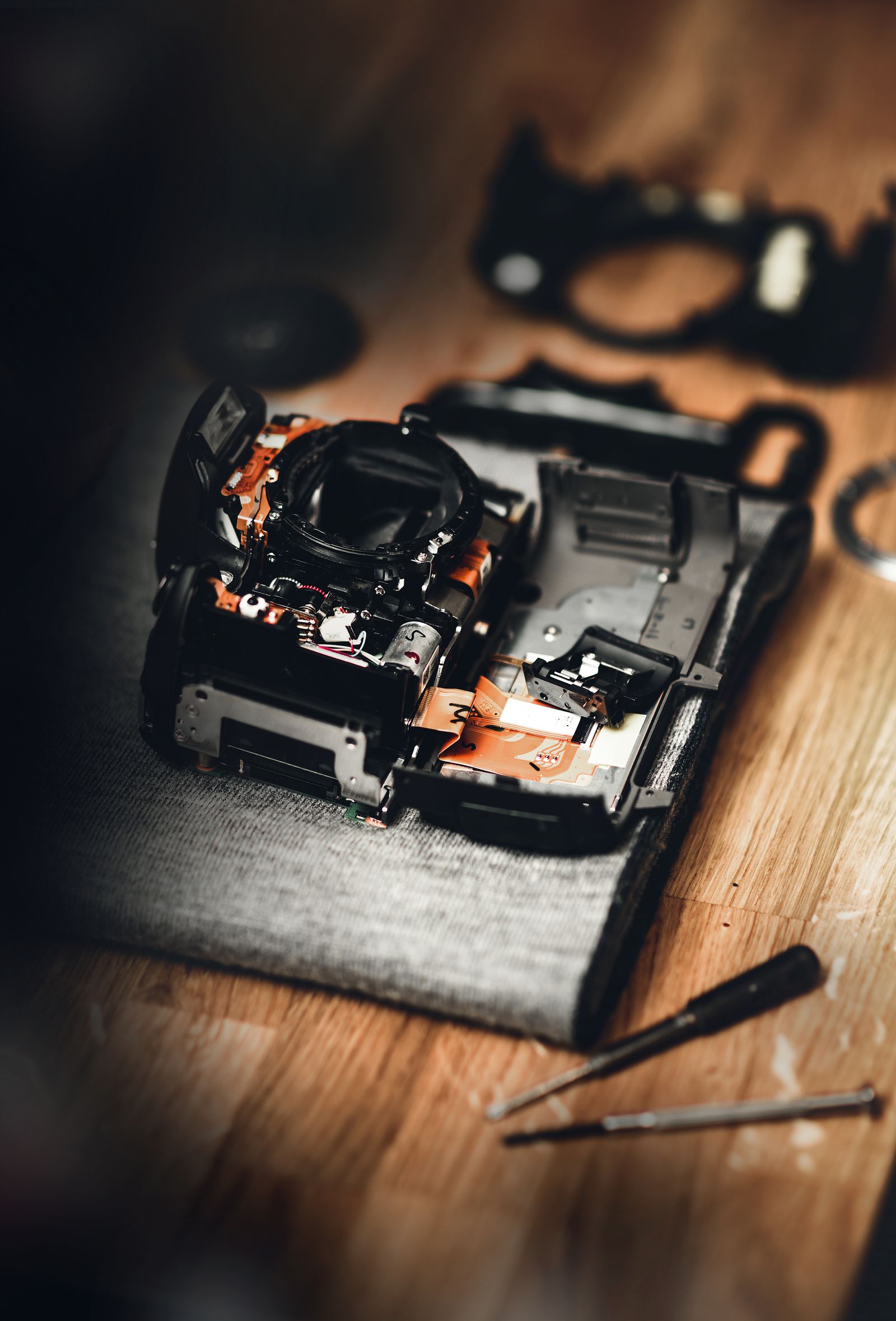
Camera opened on a repair bench — photo by Alex Andrews, https://www.pexels.com/photo/821642/
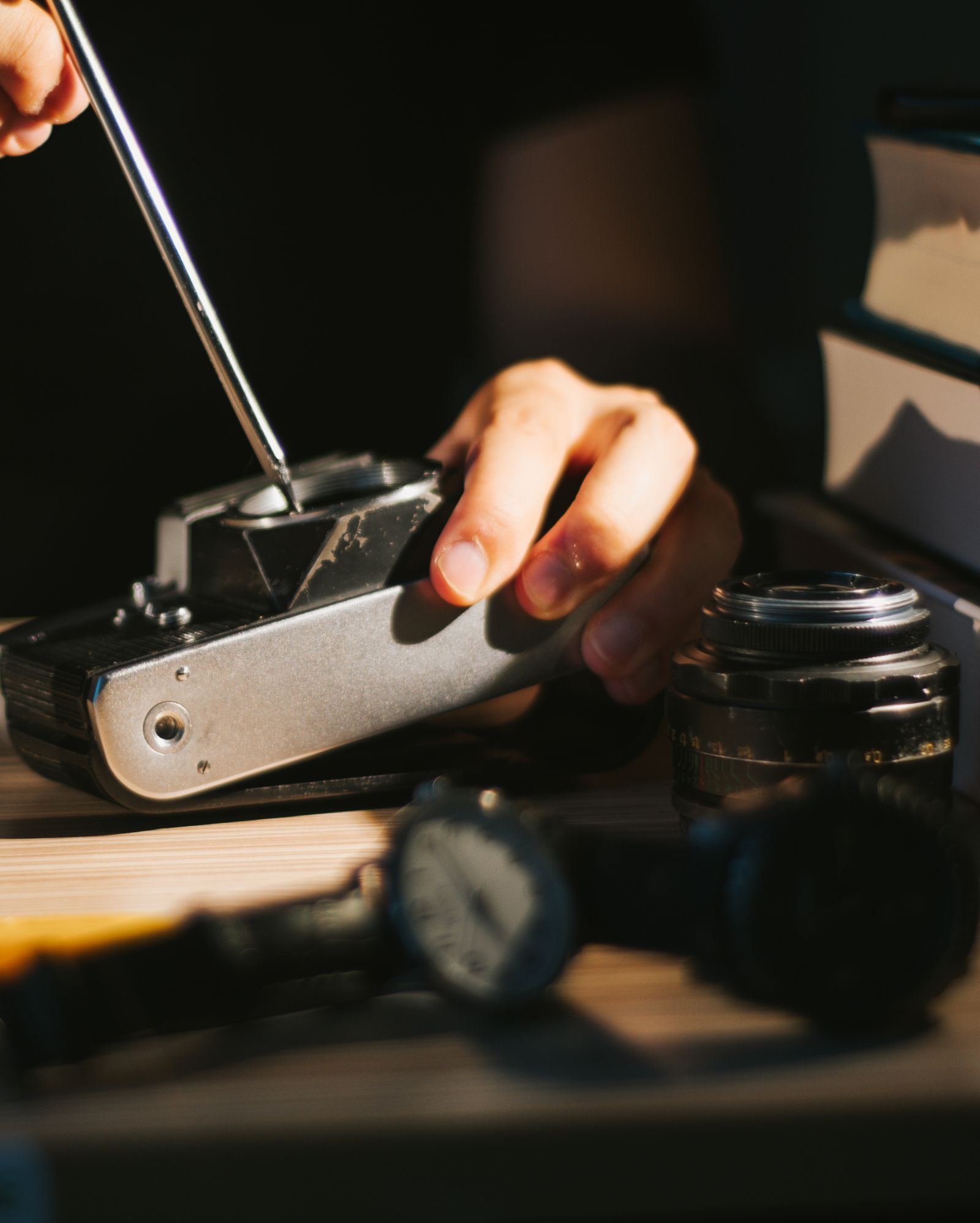
- Hands repairing a vintage camera — photo by Ahmet Polat, https://www.pexels.com/photo/5587333/
More guides
- How to Find a Wedding Photographer: The Complete, Honest GuidePhotographers › Wedding Photographers
- How Much Does a Wedding Photographer Cost? Packages DecodedPhotographers › Wedding Photographers
- 10 Questions to Ask a Wedding Photographer Before You BookPhotographers › Wedding Photographers
- Wedding Photography Styles Explained: Documentary, Editorial, Traditional, Fine ArtPhotographers › Wedding Photographers
- Hiring a Wedding Photographer in California: Venue Light, Permits, and Price LevelsPhotographers › Wedding Photographers
- All Guides & ArticlesBrowse the full guides library