Photographers › Photo Retouching & Coloring
Reviews of Photo Retouching and Coloring Providers, Read Properly: Separating Signal From Noise
When I managed a portrait studio, our reviews were a strange mirror. The five-star ones made us feel wonderful and told us almost nothing. The useful ones were longer, a little annoyed, and very specific: the gallery arrived a day late during prom season, the retoucher had smoothed a grandmother's face until her own daughter complained, a product seller's red dress came back orange. Those sentences changed how we worked. The praise did not.
That is the skill this guide teaches, applied to a trade where reviews matter more than most. Photo retouching and coloring is invisible work bought sight unseen: you send files to someone you may never meet, and you judge the result on a screen, often under deadline, for photographs that have to convert — a listing that has to sell a product, a portrait a client has to love, a colorized family photograph that has to feel true. This site lists more than 3,100 photo retouching and coloring providers, and nearly all of them have stars next to their names somewhere. The stars are the least interesting part. Here is how to read what is underneath them.

First, understand why the average is lying to you a little
Online ratings do not distribute the way school grades do. Research on review platforms has repeatedly found a J-shaped distribution: lots of five-star reviews, a smaller tail of one-star reviews, and a thin middle. One widely cited explanation is two self-selection biases working together — people who already liked a product or provider are more likely to buy in the first place, and people with polarized experiences, delighted or furious, are more likely to bother posting than people whose experience was merely fine.
For retouching, that shape has a practical consequence. A provider at 4.9 stars and a provider at 4.6 stars may have done identical work; the difference may be how aggressively each one asks happy clients to post, and when. Meanwhile the merely satisfied majority — the clients whose portraits came back clean, on time, neither thrilling nor disappointing — are underrepresented in both sets of reviews. You are not reading a census. You are reading dispatches from the extremes, plus whoever was prompted.
So do not shop by decimal point. Read for pattern, specificity, and fit with your job. That is slower than sorting by rating. It is also the only method that works.
The sentences that predict your experience
A useful retouching review names a job, a decision, and an outcome. Learn to hunt for these five kinds of detail, because each one maps to a failure mode you can actually suffer.
Skin and texture, in portraits. The most common technical complaint in portrait retouching, across both reviews and professional guidance, is over-smoothing: skin polished until pores and fine lines vanish and the face reads as plastic or waxy. Good retouching reduces distractions — a temporary blemish, blotchy tone — while keeping texture, often by working on tone and texture separately. So a review that says "she still looked like herself, just rested" is gold; it describes restraint, the hardest skill in the trade. A review that says "flawless, porcelain skin!" is ambiguous — read the attached photos, if any, at full size. And a review complaining that a subject "looked ten years younger but not like my mother" is telling you the provider's house style overrides likeness. Believe it, whichever side of that trade you are on.
Color truth, in product and coloring work. For sellers, the expensive failure is color drift: the product that arrives at a customer's door does not match the photograph, and the photograph was the retoucher's doing. Professional guidance on retouching mistakes returns to this again and again — casts introduced by mixed lighting, saturation pushed until a color becomes a different color, skin tones pulled orange, yellow, or gray. In reviews, look for the words "true to life," "matched the sample," or, in complaints, "came back orange," "too warm," "not the color I sent." For colorization of black-and-white photographs, the equivalent signal is a reviewer who discusses research — uniform colors checked, a family member consulted about a dress — versus one who only says the result was "beautiful." A beautiful guess is still a guess.
Consistency across a batch. Anyone can retouch one hero image carefully. Catalog and event work is hundreds of images that must look like they belong together. Reviews from other high-volume clients — "300 SKUs, all matched," or the complaint version, "every photo looked edited by a different person" — predict your batch experience better than any single-image praise. Inconsistent editing across a gallery is a recognized professional failure, not a matter of taste, and reviewers who mention it by describing mismatched brightness, skin tone, or white balance across a set are giving you diagnostic information.
Turnaround, stated as dates. "Fast!" means nothing. "Sent 80 images Tuesday, proofs back Thursday, two days before my listing deadline" means everything. Published retouching services price speed explicitly — delivery windows from hours to several days, with rush as a paid tier — so a provider's reviews should show a pattern of hitting stated windows, especially in peak season. Note reviews written in November and December and before wedding season; a studio that holds its turnaround in its busiest month will hold it in yours.
Revisions, and how they were handled. Almost every retouching job needs one revision round; taste is involved and briefs are imperfect. The predictive review is not "no revisions needed" — it is the one that describes asking for a change and getting it without argument, surcharge surprises, or a three-day silence. Conversely, reviews describing revision fees that were never quoted, or a provider who defended the first version instead of fixing it, describe your future dispute in advance.

The patterns that mean nothing
Just as important is what to discount.
Generic praise with no job in it. "Amazing work, highly recommend, five stars" could have been written about a plumber. The Federal Trade Commission's guidance on evaluating reviews makes the underlying point plainly: consider the source, and be aware that some reviews are fake, paid for, or manipulated — and that fakes are not always positive, since competitors sometimes plant negative ones. The FTC also notes you often cannot tell a fake from a real review by looking at one alone. What you can do is weight specificity. Enthusiasm that never touches a detail — no file type, no deadline, no kind of photograph — carries almost no information, genuine or not.
Bursts and clusters. The FTC advises checking how recent reviews are and watching for a burst of reviews over a short period, which can signal fabrication. Apply that here: a retoucher who collected eleven five-star reviews in one week after two years of silence has had a campaign, not a breakthrough. Also check the reviewer, where the platform allows it — an account created to post a single review deserves less weight than a working photographer's account with a history across many providers.
The single furious review. One-star reviews are data, but read them for what the client asked for. Retouching has an irreducible taste layer: a client who wanted heavy glamour retouching and hired a natural-style retoucher will write a sincere, furious review of excellent work. If the complaint is "she refused to slim my arms / change my face shape," and you do not want that either, the review is actually an endorsement. Read one-star reviews as descriptions of the provider's boundaries, then decide whether those boundaries are yours.
Star counts across different kinds of work. A provider's rating usually blends every job type they take. Five hundred delighted background-removal clients will bury the experience of the three clients who commissioned high-end beauty retouching. If your job is the minority job — colorization, say, or editorial skin work — filter ruthlessly for reviews of that job, and treat the overall rating as background noise.
| What you read | What it actually tells you |
|---|---|
| "Still looked like herself, just rested" | Restraint with skin texture — the core portrait skill |
| "Colors matched the physical sample" | Color discipline; low return risk for sellers |
| "All 300 images matched each other" | Batch consistency, the catalog skill that matters most |
| "Sent Tuesday, proofs back Thursday" | A turnaround claim you can test against your deadline |
| "Fixed my revision note in one round, no fuss" | How your own revision will go |
| "Amazing!!! Highly recommend!!!" | Nothing — no job, no detail, no information |
| Eleven five-star reviews in one week | A solicitation campaign, not a change in quality |
| One furious review about refused face-reshaping | The provider's boundaries — possibly a point in their favor |
Read the middle, and read across places
Two habits separate careful readers from star-shoppers. First, start with the three- and four-star reviews. Research on review usefulness has found that readers judge extreme and negative reviews as more useful than moderate praise, which is partly bias — but the three-star review has a structure the extremes often lack: something worked, something did not, and the reviewer had to decide whether it was worth it. That is exactly your decision. In retouching reviews, the middle is where you find the honest trade-offs: "skin work is beautiful, color runs warm, ask for a cooler proof"; "slow in October, worth it if you book early."
Second, read the same provider in more than one place, and privilege places the provider does not control. A testimonial page on a retoucher's own website is advertising copy with quotation marks. The FTC's longstanding advice is to consult a variety of sources, including independent ones. For a retoucher, compare their marketplace reviews, their Google reviews, and what photographers say about them in professional forums or groups. Agreement across independent places is the strongest signal available to you; a glowing average in exactly one place, especially the provider's own site, is the weakest.
Also note what is missing. A coloring specialist with forty reviews and none that mention historical accuracy, reference photographs, or family consultation may be doing decorative coloring, however happy the clients are. Absence in reviews is evidence about what a provider's typical job — and typical client — actually is.
Turn reading into a test
Reviews narrow a field; they should not finish the decision. The retouching trade has a built-in verification step that most service trades lack: the paid test. Once reviews have taken you from thousands of listings to two or three candidates, send each the same small, real test — not your easiest image, but a representative hard one: mixed lighting, a face with texture you want kept, a product color that must match. Published per-image pricing makes this cheap insurance: single-task edits from outside services start under a dollar an image, basic retouching sits in the low single digits, and high-end beauty or jewelry work starts around ten dollars an image and rises from there — so a three-image test across three providers costs less than one botched batch.
Judge the test the way you learned to judge reviews: skin that still has pores, color that matches the physical product or the reference, a batch of three that matches itself, delivery inside the promised window, and a revision, if you request a small one, handled graciously. A provider who will not do a paid test at all is telling you something no review can.
A short protocol to keep
- Ignore the decimal. Note the shape: how many reviews, over how long, with what bursts.
- Filter for your job type — portrait skin, product color, batch catalog, colorization — and read only those closely.
- Start in the middle ratings; mine them for trade-offs.
- Extract specifics: texture, color truth, consistency, dated turnaround, revision behavior. Discard praise and fury that name no detail.
- Cross-check in at least one place the provider does not control.
- Shortlist two or three, then run the same paid test image past each and judge it at full size.
Do that, and reviews become what they should have been all along: not a score to obey, but other clients' lab notes on work you are about to commission. The stars will still be there, twinkling. You will just know which sentences underneath them were worth reading.
Sources
- Federal Trade Commission, "How To Evaluate Online Reviews" — consider the source; watch for bursts of reviews in a short period and single-review accounts; fake reviews can be negative as well as positive; consult a variety of independent sources.
- Hu, Pavlou and Zhang, research on the J-shaped distribution of online reviews — purchasing and under-reporting biases push ratings toward the extremes, making the mean a biased measure of quality.
- Brandes and Godes, research on extremity bias in online reviews — extreme ratings are disproportionately posted relative to moderate experiences across platforms.
- Roh and Yang, study of 951,178 Yelp reviews in Social Behavior and Personality — extreme and negative reviews are judged more useful by readers than moderate, positive ones.
- Imagen, "Common Portrait Retouching Mistakes" — over-smoothing skin into plastic, lost highlight texture, and color casts pulling skin tones unnatural are the recurring portrait failures.
- Lars Miller Media, "Product Photography Retouching: Levels, Costs and Rules" — outside editing rates from about $0.25–$1.19 per image for single tasks, with high-end jewelry and fashion work from $10 per image.
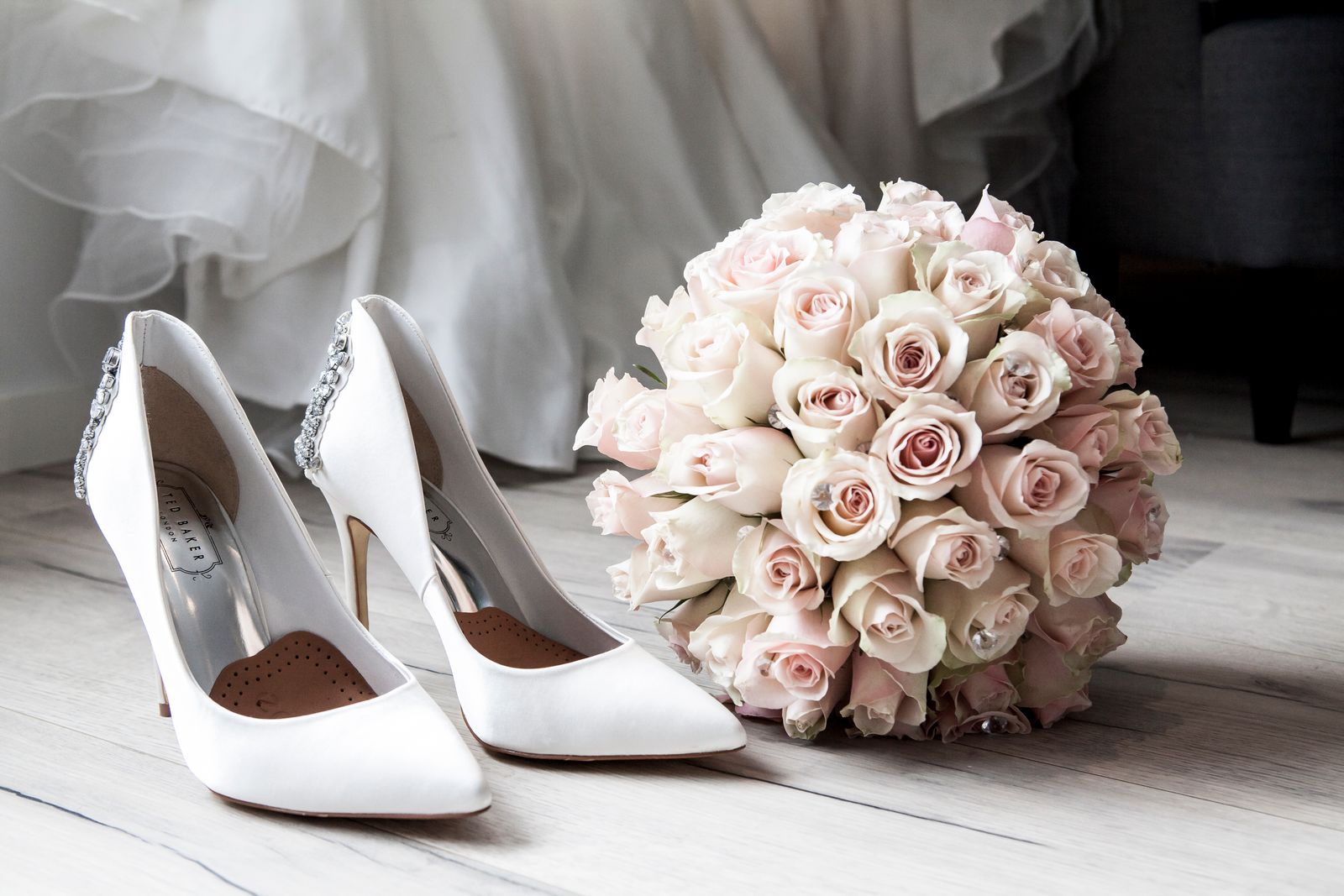
Photos: retoucher at desk — photo by Darlene Alderson, https://www.pexels.com/photo/7971616/ ; sneaker product shot — photo by J. S. J. S., https://www.pexels.com/photo/18190257/ ; bridal shoes and bouquet — Pexels photo 313707, https://www.pexels.com/photo/313707/
More guides
- How to Find a Wedding Photographer: The Complete, Honest GuidePhotographers › Wedding Photographers
- How Much Does a Wedding Photographer Cost? Packages DecodedPhotographers › Wedding Photographers
- 10 Questions to Ask a Wedding Photographer Before You BookPhotographers › Wedding Photographers
- Wedding Photography Styles Explained: Documentary, Editorial, Traditional, Fine ArtPhotographers › Wedding Photographers
- Hiring a Wedding Photographer in California: Venue Light, Permits, and Price LevelsPhotographers › Wedding Photographers
- All Guides & ArticlesBrowse the full guides library