Photographers › Wedding Photographers
Wedding Photography in South Carolina: A Resident's Guide to Costs and Rules
National wedding advice assumes a national wedding. South Carolina doesn't have those. It has a destination market on the coast where Charleston prices behave like a much bigger city's, inland markets where the same coverage costs half as much, a sales-tax rule that turns on whether your photographs arrive as a download or on a USB drive, a hurricane season that sits squarely on top of the prettiest wedding months, and — in Charleston — a city permit system for taking wedding photographs in the very parks every couple wants in the background. If you live here and you're booking a photographer for the first time, this is the local version.
What wedding photography actually costs here
South Carolina is really three photography markets sharing a state line:
| Market | Typical full-day photography | What drives it |
|---|---|---|
| Charleston & the Lowcountry coast | $3,500–$8,000 for experienced mid-range coverage; $10,000+ for established editorial and film specialists | Destination demand — a large share of couples marry here from out of state |
| Columbia, Greenville & the Upstate | Roughly $1,800–$4,000 for full-day coverage from established local studios | Resident market, priced for the people who live there |
| Elopements & intimate weddings statewide | $1,500–$3,500 for short coverage | Fewer hours, smaller teams |
The Charleston numbers deserve a moment, because they surprise residents most. Charleston market guides consistently place beginner photographers at $2,500–$4,500, mid-range photographers at $5,000–$8,000, and specialists — film shooters, destination names, full-weekend coverage — starting around $10,000. One widely used cost estimator, working from what couples actually reported spending rather than rate cards, puts Charleston photography alone at roughly $3,182–$3,890 for a 125-guest wedding, with photography and video together at $5,880–$7,186. Meanwhile, statewide services that send photographers anywhere in South Carolina advertise eight hours with one photographer at $1,795 and two photographers at $2,395 — real prices, from a volume model, and a useful floor when you're judging whether a quote is out of line or just Charleston being Charleston.
The honest summary: if your wedding is in Charleston on a Saturday in April or October, budget like it's a destination wedding, because the market thinks it is one. Anywhere else in the state, national mid-range advice roughly holds.
The sales-tax rule that depends on a USB drive
South Carolina has a photography tax rule most couples never hear about until it appears — or conspicuously doesn't — on an invoice. Under the Department of Revenue's Revenue Ruling #15-10, which governs how photographs are taxed in this state:
- Photographs sold in printed form are subject to South Carolina sales tax.
- Photographs delivered on a tangible medium — a USB flash drive, CD or DVD — are also taxable, as a sale of tangible personal property. It doesn't matter who supplied the drive.
- Photographs delivered purely electronically — as an email attachment or a download from the photographer's gallery — are not subject to South Carolina sales tax.
- If the same photographs come to you both ways, the tangible delivery makes the sale taxable.
For a couple, the practical consequence is simple: a download-only package and an identical package with an album and a USB drive are taxed differently in South Carolina, on top of the album's own price. When you compare quotes, compare them as delivered totals, and don't be surprised — or suspicious — when the tax line differs between two photographers whose packages are structured differently. It is the delivery method, not the photographer, doing that.
Charleston's permit rule: the parks are not free backdrops
If your portrait plans involve Charleston's postcard locations — the Battery, White Point Garden, Waterfront Park, Hampton Park — know that the City of Charleston runs a film and photography permit system, and wedding photography is inside it. Wedding photos taken in a city park require a city film and photography permit, and photography in a public park, field or facility also requires a park reservation permit from the Recreation Department, with hourly per-location fees. Park reservations must be made at least five days in advance, and permit applications generally need ten business days. Events at Waterfront Park and White Point Garden are capped at 25 people, and amplified sound is prohibited in White Point Garden altogether.
Two working consequences. First, the timeline: a photographer who shoots in Charleston parks regularly will handle the permit as a matter of routine — ask, before you book, whether your portrait locations need one and who files it. Second, the tide: the Battery's seawall promenade takes spray and standing water at spring high tides, and local photographers schedule Battery portraits against the tide table, with White Point Garden — a few yards inland, under the live oaks — as the all-tides alternative. A photographer who proposes the Battery without mentioning tides is telling you something about their local experience.
Plantations and historic venues — the Magnolias and Boone Halls of the world — run their own rules on top of the city's: professional sessions are arranged with the venue in advance, usually against admission or a site fee. Your venue contract, not the internet, is the authority there.
The calendar is a rule, too
South Carolina's wedding seasons are dictated by three facts: heat, humidity and hurricanes.
Spring (March–May) is the first peak: azaleas and wisteria, highs in the 70s and low 80s, manageable humidity. Charleston venues and photographers book 12–18 months out for prime spring Saturdays, and late May brings Spoleto Festival USA, which fills the city and its hotels — check festival dates before you fall in love with a late-May weekend.
Summer (June–August) is the discount season for a reason: highs around 90°F with intense humidity and routine afternoon thunderstorms. Summer weddings here work when they're built for it — evening ceremonies, indoor or fully shaded receptions, a rain plan that isn't an afterthought — and photographers price and plan accordingly. Ask a summer photographer how they handle a 4 p.m. thunderstorm over an outdoor ceremony; the answer is a genuine competence test in this state.
Fall (September–November) is the second peak, and October is the sweet spot: average highs around 78°F, the humidity broken, the light low and warm. It is also, still, hurricane season. The Atlantic season runs June 1 through November 30, with peak risk in August and September — which means it covers most of both wedding peaks. The local-standard defenses are contractual, and you should insist on them in writing: a rescheduling clause that names hurricanes and mandatory evacuations specifically, clarity on what happens to your deposit if the date moves, and wedding insurance for any coastal date in season. Photographers who work the coast have a storm policy. Ask what it is before you sign, not when a named storm is in the cone.
Winter (December–February) is the quiet bargain: mild, drier, early sunsets, and vendors with actual availability.
Beyond Charleston: beaches, islands and the inland markets
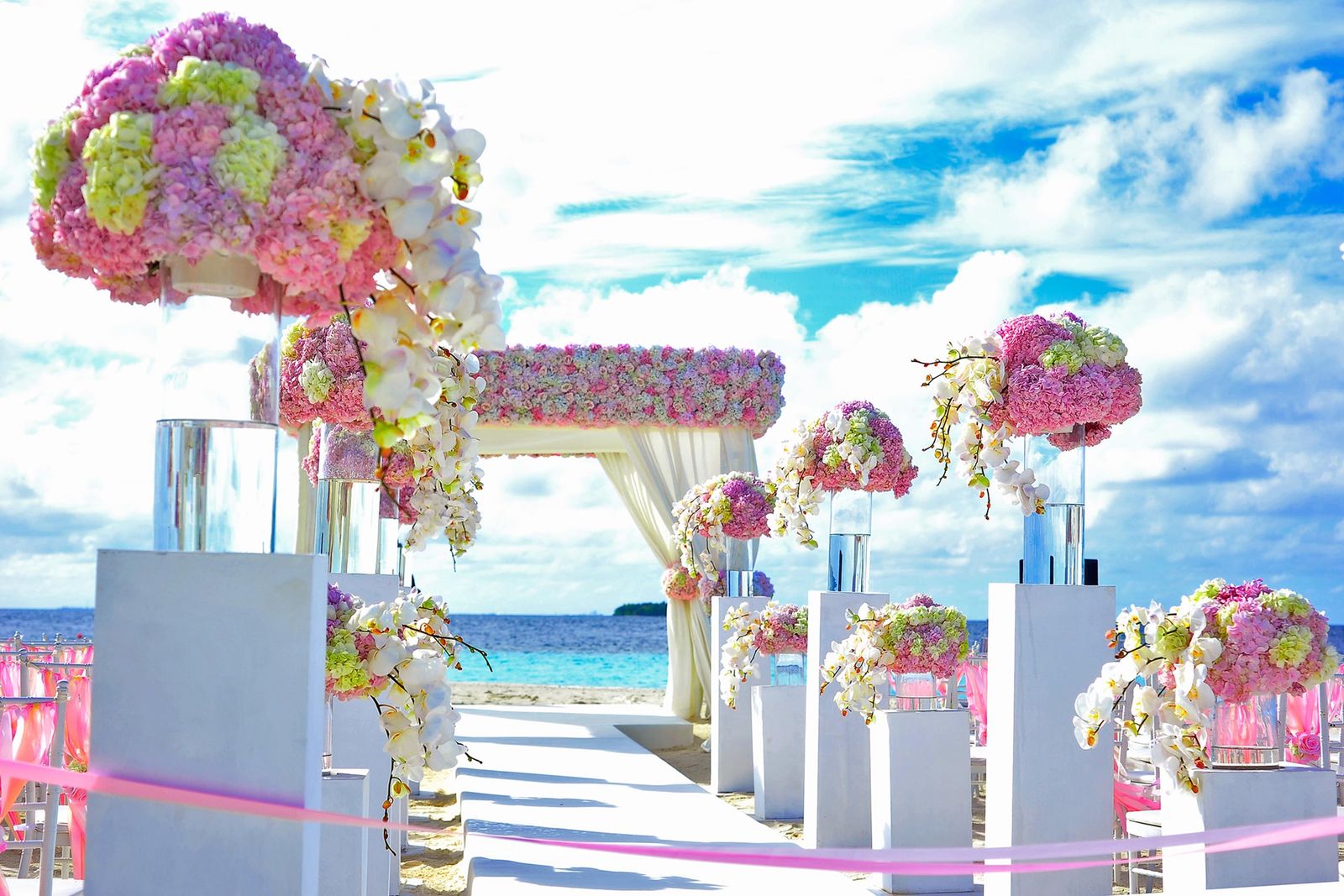
Charleston gets the attention, but a large share of South Carolina weddings happen on sand. Hilton Head Island, Isle of Palms, Folly Beach, Pawleys Island and the Myrtle Beach strand all host beach ceremonies, and the governing rule is the same everywhere even though the paperwork differs by town: a wedding on a public beach is an event on public property, and most coastal towns require a permit or at minimum advance notification for ceremonies — with separate rules again for anything beyond the ceremony itself, like chairs, arches and amplified sound. Isle of Palms, for example, also permits commercial photography on public property with an exception for a photographer simply fulfilling an existing booking. The working approach is unglamorous and reliable: your photographer and planner confirm the current rules with the specific town before the date is announced, because beach rules change by ordinance and season, and "the couple last year didn't need one" is not a permit.
Inland, the rules relax and the prices do too. Greenville's downtown and the mountain venues toward the North Carolina line, Columbia's riverfront and historic homes, and the plantation and farm venues of the Midlands run on venue contracts rather than city permit systems, and the photographers are priced for a resident market. The trade-off is travel: a Charleston name shooting a Greenville wedding will quote travel on top, while a strong local Upstate photographer won't. When the portfolio gap is small, local wins on both price and weather knowledge — an Upstate photographer's storm plan involves summer pop-ups over the foothills, not a tide chart, and that local fluency is worth money in both directions.
One more statewide practical point: South Carolina's most-photographed backdrops — live oaks with Spanish moss, marsh at low tide, historic brick — are at their best in the same golden hour every photographer wants, and sunset times swing widely between a June wedding and a November one. Build the portrait block backwards from sunset on your actual date, not from a sample timeline written for another month.
Licensing and business rules, briefly
South Carolina does not license photographers as a profession — there is no state photographer's license to check, the way there is for cosmetologists or contractors. What a legitimate South Carolina photography business does have is a retail license for collecting the sales tax described above, and usually a local business license from its city or county. So vet on the things that substitute for a license: a real contract, liability insurance (venues increasingly require certificates from every vendor), a portfolio of complete weddings rather than styled shoots, and references from venues you've heard of. This site lists 564 wedding photographers among its photography listings — the bench is deep in every market in the state, and there is no reason to book the one who can't produce a contract.
Questions to ask a South Carolina photographer
- Is your quote the delivered total — including South Carolina sales tax as it applies to how my photographs will be delivered?
- For Charleston park portraits: which permits does our plan need, who files them, and what do they cost?
- What does your contract say about hurricanes, evacuations and rescheduling — specifically?
- If we're shooting at the Battery or on the coast, how do you plan around tides and afternoon storms?
- Are you insured, and can you provide a certificate to our venue?
- How far out are you booked for spring and October Saturdays — and what does that make our realistic date options?
The resident's summary
Budget Charleston like a destination market and everywhere else like a hometown one. Read the tax line as a delivery-method question, because in South Carolina that's literally what it is. Treat permits as your photographer's job but your responsibility to confirm. And plan the calendar around the state's real constraints — spring pollen, summer storms, fall hurricanes — with the storm clause in the contract before the deposit moves. Do those four things and the national advice works fine for the rest.
Sources
- Fisher Film & Photo, "Charleston SC Wedding Photographer Cost: 2026 Pricing Guide" — Charleston tiers: beginners $2,500–$4,500, mid-range $5,000–$8,000, specialists from $10,000.
- Vera Monet, "How Much Does a Charleston Wedding Cost in 2026?" — photography at $3,500–$8,000 within a $45,000–$95,000 total wedding range; Charleston as a destination market.
- The Wedding Report, Charleston cost estimates — photography at $3,182–$3,890 and photography plus video at $5,880–$7,186 for a 125-guest spring wedding, from reported couple spending.
- Stories and Stills, "Wedding Photographer Cost in South Carolina (2026)" — statewide eight-hour coverage at $1,795 with one photographer and $2,395 with two, no travel fees.
- South Carolina Department of Revenue, Revenue Ruling #15-10, "Photographers — Photographs Sold in Tangible or Electronic Form" — printed and tangible-media photographs are taxable; purely electronic delivery is not; combined delivery is taxable.
- City of Charleston, Film and Photography Permit Application and park reservation rules — permits for photography in city parks, reservations at least five days ahead, applications ten business days ahead, 25-person caps at Waterfront Park and White Point Garden.
- Emmy Kienast Photography, "Married in Charleston: A Lowcountry Wedding Guide" (2026–2027 edition) — season-by-season weather, hurricane season June 1–November 30, and 12–18-month booking horizons for peak dates.
Photographs
- Beach ceremony — photo via Pexels, https://www.pexels.com/photo/169192/
- Couple under veil — photo via Pexels, https://www.pexels.com/photo/2253870/
- Couple portrait — photo by Sandro Crepulja, https://www.pexels.com/photo/3361200/
More guides
- How to Find a Wedding Photographer: The Complete, Honest GuidePhotographers › Wedding Photographers
- How Much Does a Wedding Photographer Cost? Packages DecodedPhotographers › Wedding Photographers
- 10 Questions to Ask a Wedding Photographer Before You BookPhotographers › Wedding Photographers
- Wedding Photography Styles Explained: Documentary, Editorial, Traditional, Fine ArtPhotographers › Wedding Photographers
- Hiring a Wedding Photographer in California: Venue Light, Permits, and Price LevelsPhotographers › Wedding Photographers
- All Guides & ArticlesBrowse the full guides library